
Perfume buyers: 6 chain of custody checks for decant authenticity
Decants are authentic when they hold genuine liquid poured from an original bottle, but the label alone proves nothing. Confidence comes from provenance, not packaging. Two things decide whether you can trust one: whether the seller can show where the juice came from, and whether it has been stored and handled correctly since. The Perfume Sampler and other reputable sellers build their reputation on exactly these two points.
TL;DR:
- Confirm the seller can provide clear provenance photos of the original source bottle alongside the decant, not just stock images.
- Verify the seller has consistent reviews, a reputable online presence, and proper handling practices for the decants sold.
- Watch for signs of mishandling upon arrival, such as off notes or discoloration, and store the decant in a cool, dark place to maintain quality.
- Understand that decants lack brand-imposed traceability, making provenance and handling the primary proofs of authenticity.
- Use buyer-protected payments and check return policies, as reputable sellers document their sourcing and offer guarantees to reduce risk.
Table of Contents
- What is a decant, and how does it differ from a factory sample?
- How do you verify a decant’s authenticity before buying?
- What risks does decanting introduce after you buy?
- Are decants legal, and does that affect authenticity?
- What does a trustworthy decant seller actually document?
- When does a decant actually make sense?
- Where can you buy decants you can actually trust?
- Sources
- FAQ
What is a decant, and how does it differ from a factory sample?
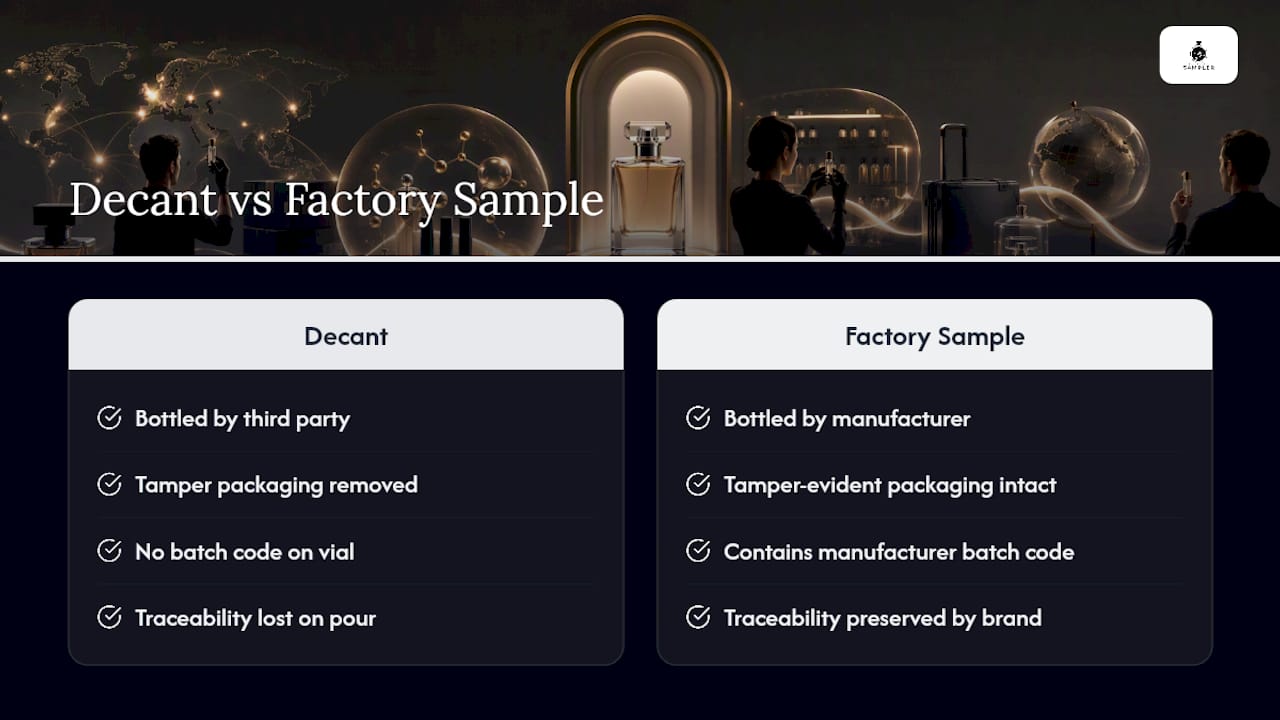
A decant is perfume that has been transferred from a full, sealed bottle into a smaller vial by a third party, not by the brand. That single fact explains almost every authenticity question that follows.
A factory sample, by contrast, is bottled and sealed by the manufacturer, with its own batch code and tamper-evident packaging intact. A decant removes that packaging entirely, which means the liquid can still be completely genuine, but the traceability the brand built into the bottle is gone the moment it’s poured. That is not a flaw unique to any one seller. It’s simply what decanting is.
Buyers accept this trade-off for good reason: decants let you test niche and designer scents before committing to a full bottle, try rare or discontinued releases you’d never buy blind, and avoid paying full price for a fragrance you might wear twice. The value is real. It just shifts the burden of proof from the packaging onto the seller.
How do you verify a decant’s authenticity before buying?
Treat every decant purchase as a chain-of-custody question rather than a label-reading exercise. The seller’s job is to prove where the liquid came from and how it has been handled since. Yours is to check that proof properly.
Work through this before you commit to a purchase:
- Ask for provenance photos showing the decant vial alongside the original source bottle in the same frame, not a stock image or a photo pulled from elsewhere online.
- Check the seller’s history, including consistent customer reviews over time, a visible presence on fragrance forums, and evidence of repeat sales rather than a brand-new account with no track record.
- Inspect fill levels and labelling for consistency across listings; mismatched fonts, vague scent names, or fill lines that don’t match the stated volume are worth questioning.
- Look at the atomiser or vial condition. A fresh, clean spray top and clear glass suggest careful handling; cloudy residue or a scuffed, reused container does not.
- Use buyer-protected payment methods and check the returns policy before paying. A seller who insists on direct bank transfer or refuses returns is avoiding accountability, not saving you money.
- Do the sample-size arithmetic. If someone claims to be selling dozens of 5ml decants from a single 100ml bottle, work out whether the maths actually holds up given normal wastage from decanting.
A batch code printed on a box helps you verify a full retail bottle, but it cannot, on its own, prove that the liquid in a separate vial actually came from that box. Treat batch codes as supporting evidence, never as the final word.
Pro Tip: Ask the seller one specific question about their sourcing, such as where the original bottle was purchased. A genuine seller answers confidently and specifically. A vague or defensive response is often the clearest red flag you’ll get.
What risks does decanting introduce after you buy?
Authentic juice can still perform badly if it has been mishandled, and that’s the part buyers overlook most often. Moving perfume out of its engineered original bottle exposes it to variables the brand never intended.
Air, heat, and light all accelerate oxidation once a fragrance leaves its sealed container, and the material of the decant vial itself matters too. Manufacturers caution that transfers can alter stability and long-term performance in ways that are hard to verify without laboratory testing.
Watch for these signs on arrival:
- Off or sour notes that weren’t part of the fragrance’s original profile.
- Projection that fades unusually fast, even accounting for the smaller vial size.
- Discolouration compared with how the fragrance normally looks in its full bottle.
Do a small skin test as soon as it arrives, and store the decant somewhere dark and cool, well away from windowsills or bathroom heat and humidity. The container matters here too. Cheap plastics and reactive materials, the same reason retailers of items like the Innersense I Create Finish pay attention to bottle composition, can shorten a product’s usable life regardless of what’s inside it.
Are decants legal, and does that affect authenticity?
Legal complexity is not the same as fakery, and it’s worth separating the two clearly. The legal picture around decants is genuinely murky in places, largely down to the doctrine of exhaustion, which governs how far a brand’s trade mark rights extend once a product has been sold. That doctrine varies by territory, which is why legal responses to decanting differ from one market to another.
Brands sometimes object to resales that alter packaging or create consumer confusion, and that objection is often about protecting brand image and quality control rather than accusing every decant seller of selling fakes. For a buyer, the practical takeaway is straightforward: legal grey areas don’t tell you whether a specific decant is genuine. Your own verification checks still do the heavy lifting.
What does a trustworthy decant seller actually document?
Reputable sellers treat documentation as standard practice, not an optional extra. There’s no official registry of approved decant sellers, so the burden falls on individual sellers to build trust through consistent, verifiable behaviour.
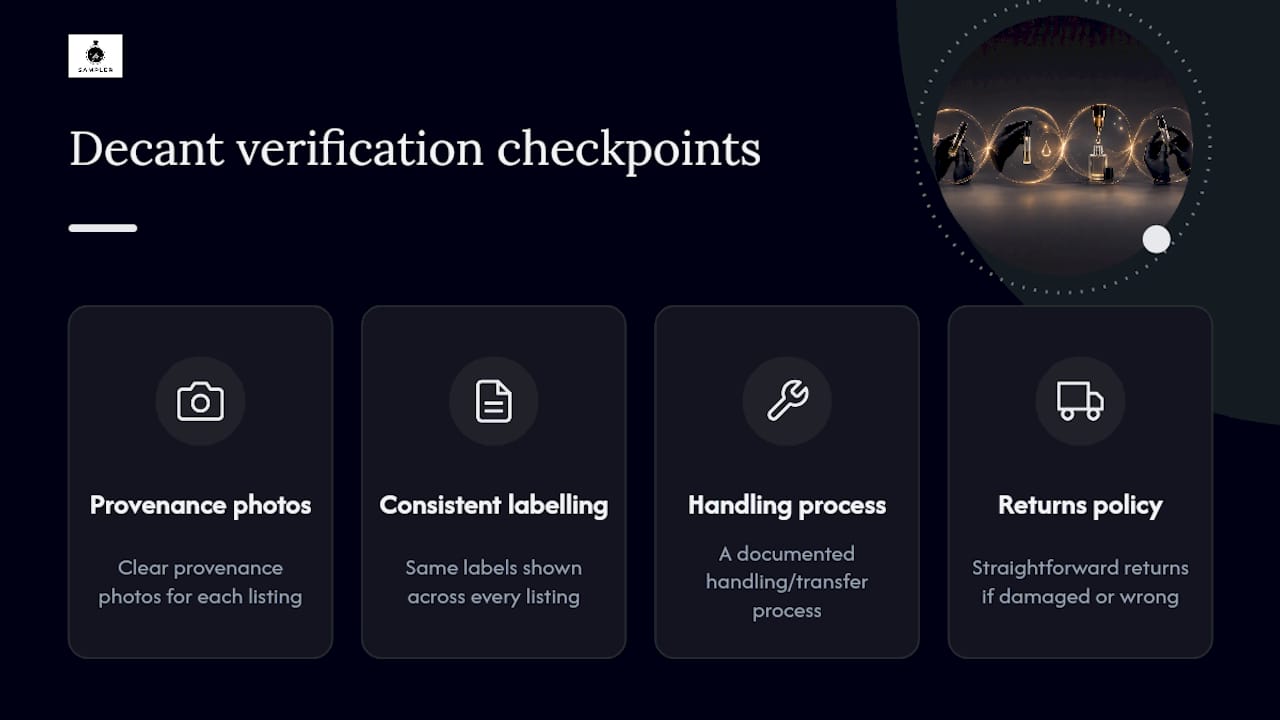
The Perfume Sampler sells decants in 2ml, 3ml, 5ml, and 10ml sizes alongside full bottles, and states an authenticity guarantee backed by a rating of “Excellent” on TrustPilot, according to the brand’s own claims. Expect any seller worth buying from to offer clear provenance photos, consistent labelling across every listing, a documented handling process, and a straightforward returns policy if something arrives damaged or wrong. If you want the mechanics explained further, what a decant actually is and how the transfer process works is worth reading before your first purchase.
When does a decant actually make sense?
Decants earn their keep when you’re sampling, testing a rare release, or covering a short-term occasion where a full bottle would be wasted money. For long-term collecting, gifting, or anywhere original packaging matters to you, a sealed bottle remains the safer call. Weigh traceability against cost and how you’ll actually use the fragrance, not just the price per millilitre.
— Rupesh
Where can you buy decants you can actually trust?
Unlike marketplace listings where you’re trusting a stranger’s photos and promises, Theperfumesampler sells decants and full bottles directly, with an authenticity guarantee attached to every order rather than left to a seller’s word.
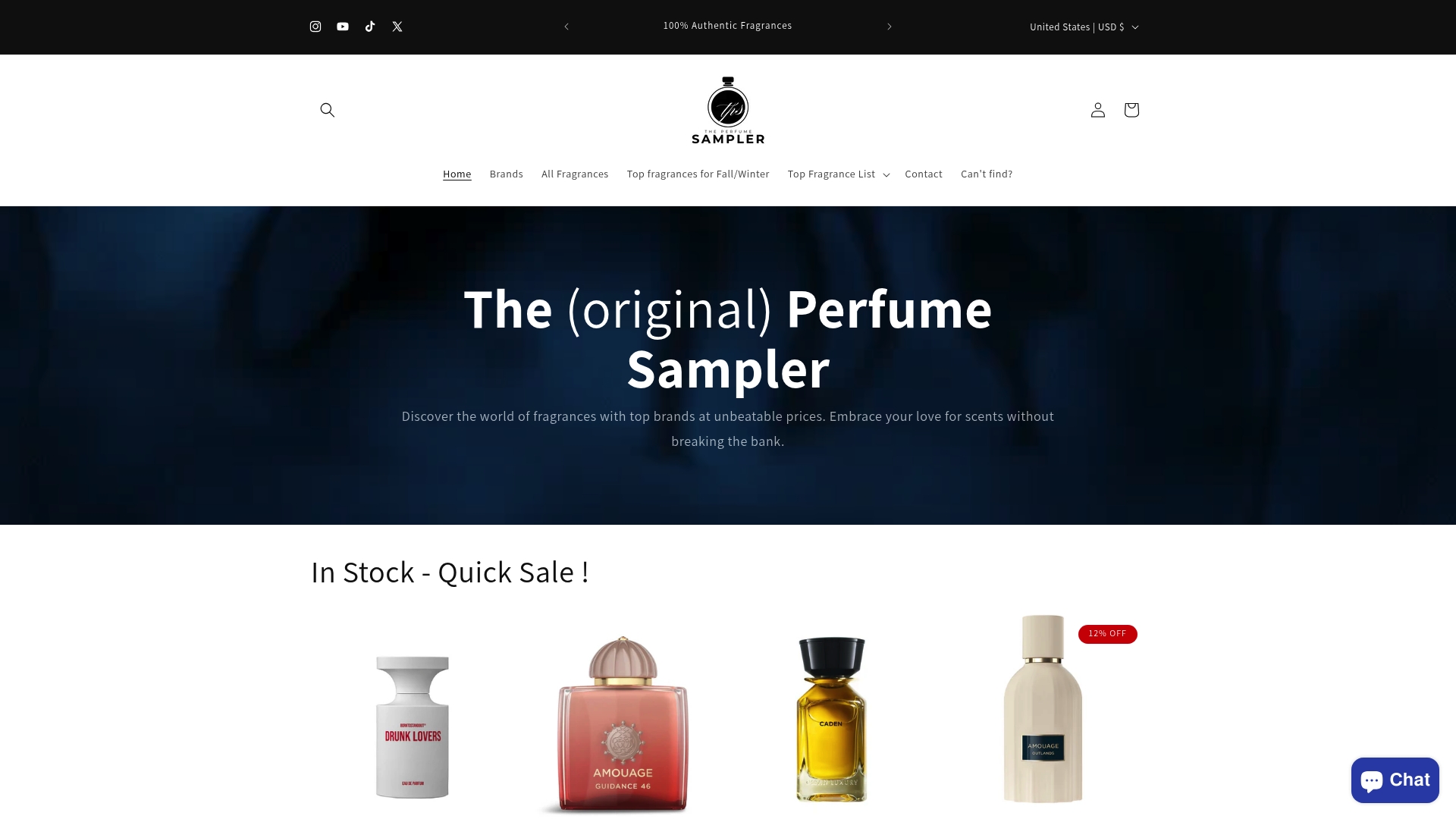
Sizes run from 2ml up to 10ml, alongside full bottles for fragrances you’re ready to commit to, covering both niche and designer names across men’s and women’s fragrance. That range means you can test something like Boss Bottled Absolu Parfum Intense in a small size first, or go straight to a full bottle if you already know it’s the one. If you’re still deciding whether decanting suits how you shop for fragrance, the Why decants? page walks through the reasoning in more detail. When you’re ready to browse, the full range of fragrances is the place to start, or head straight to full bottles if a sample has already done its job.
Sources
For a deeper look at the legal grey areas around trade mark exhaustion and why brands sometimes push back on resales, Foot Anstey’s analysis is a solid starting point. Impressive Magazine’s buyer checklist covers practical scam signals in more depth than fits here. For background on how decanting works as a market practice, Rarescents’ explainer is worth a read too.
- Perfume decant scam checks before you buy online — Impressivemagazine
- Perfume decants explained — Rarescents
- Bottled trade mark trouble? – Foot Anstey
FAQ
Are decants original perfume?
Yes, a decant is typically the same liquid poured from an original, full-sized bottle, not a separately manufactured product. The authenticity of what’s inside the vial depends entirely on whether the seller sourced it from a genuine bottle in the first place.
Is a decant seller a legitimate way to buy perfume?
Legitimacy comes down to the individual seller, not the practice of decanting itself. Look for provenance photos, consistent reviews, and buyer-protected payment options before trusting any listing, whether it’s a marketplace seller or a dedicated retailer.
Are perfume decants legit, or just a workaround?
Decants are a legitimate way to sample fragrance without buying a full bottle, provided the seller can demonstrate proper sourcing and handling. Some sellers state an authenticity guarantee across ranges of decants and full bottles.
Does a decant seller sell authentic fragrance?
That depends entirely on the specific seller’s sourcing and track record rather than the format itself. A trustworthy seller will show the source bottle, maintain consistent labelling, and offer a clear returns policy if the decant doesn’t match expectations on arrival.