
What is a bespoke fragrance? A guide for sample lovers
A bespoke fragrance is a one-of-a-kind perfume composed from scratch for a single wearer, built around their skin chemistry, scent memories, and personal brief. Nothing is selected from a catalogue. The formula does not exist until the perfumer creates it for you. For most fragrance enthusiasts, though, the practical starting point is not a commission costing hundreds of pounds and taking several months. It is a 2ml, 3ml, 5ml, or 10ml sample or decant of an existing niche or designer perfume, tested on skin over several days.
- Bespoke commission: typically several months from first consultation to finished bottle
- Sample-led testing: results within days to weeks, at a fraction of the cost
- Who provides samples: Theperfumesampler stocks 2ml–10ml decants of luxury and niche fragrances, ready to order
Pro Tip: Before spending anything on a bespoke commission, build a shortlist of five to ten scents via samples. The process of elimination teaches you more about your preferences than any consultation questionnaire.
Table of Contents
- What does ‘bespoke fragrance’ really mean?
- How does a bespoke commission actually work?
- Pros and cons of commissioning bespoke
- Affordable alternatives that still feel personal
- How to test fragrances properly using samples
- Questions to ask a perfumer before you commission
- When should you choose bespoke, and when should you sample first?
- Key takeaways
- Why sampling before committing is the smarter route
- Start your bespoke-feeling discovery with Theperfumesampler
What does ‘bespoke fragrance’ really mean?
The word bespoke has a precise origin: a garment “spoken for” before it is made, cut to one person’s measurements. Applied to perfumery, it means a formula created from scratch for one client, with no prior template and no intention of replication.
That definition matters because the term is now used loosely. Industry analysts note that “personalisation” has stretched the meaning of bespoke to cover services that are nothing of the sort. Three categories are commonly mislabelled:
- Personalised: an existing formula with minor modifications, such as a different concentration or a single added note
- Custom: a blend selected from a fixed menu of pre-made bases, assembled to your preference
- True bespoke: a formula written from a blank page, with every ingredient and its quantity chosen specifically for you
“A bespoke perfume would be a perfume created only once and for one person.” — Anaïs Fournial, perfumer
To verify a genuine bespoke offer, ask directly: Does the perfumer start from a blank formula, or from an existing base? The answer materially affects cost, exclusivity, and what you actually receive. A custom perfume built on a pre-made base is a legitimate product, but it is not bespoke in the strict sense.
How does a bespoke commission actually work?
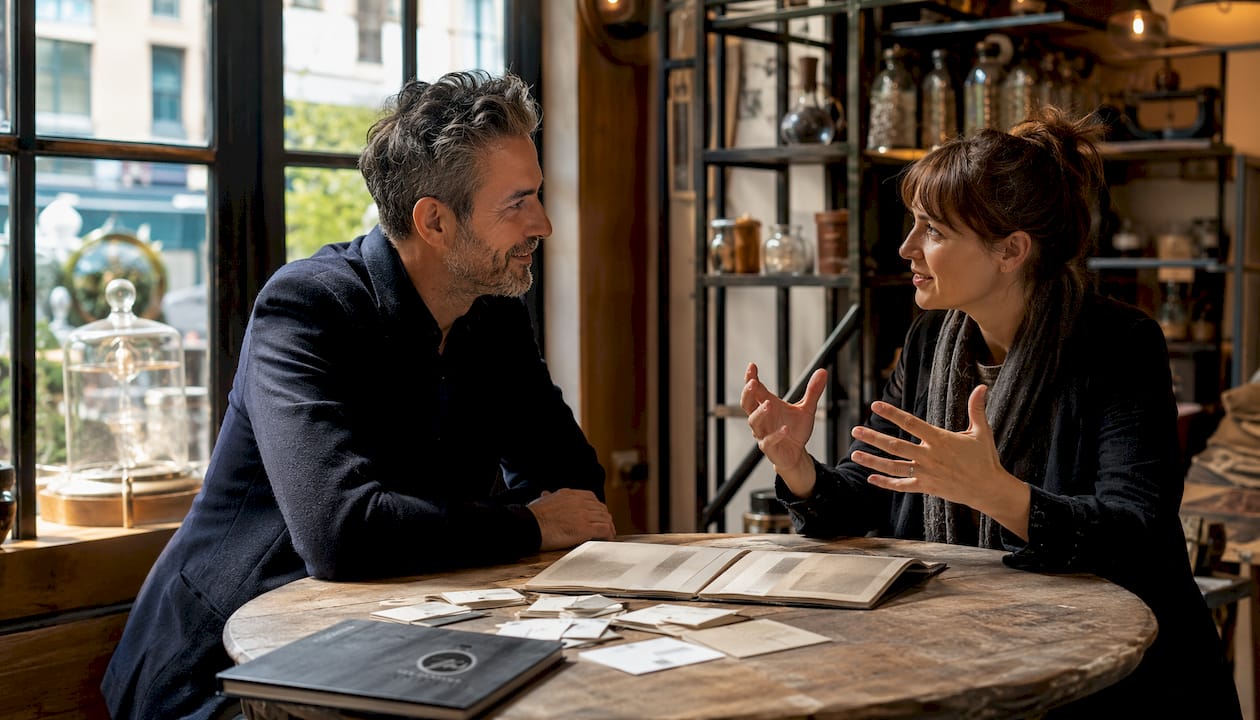
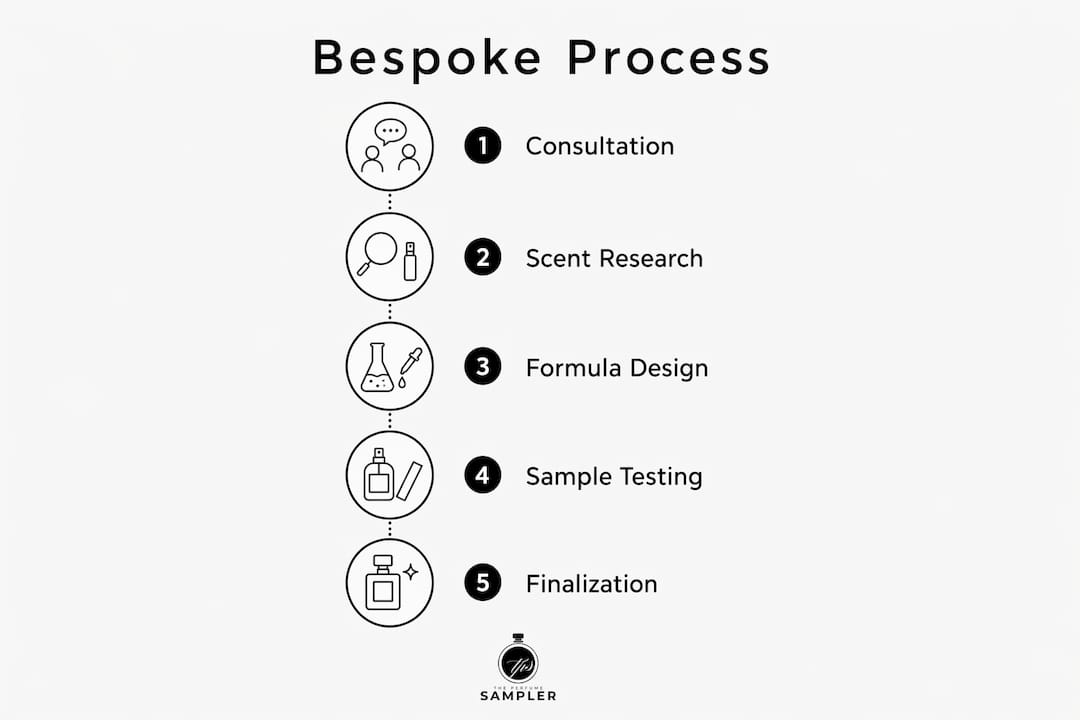
Most UK ateliers follow a broadly similar process, though timelines and fees vary by perfumer.
Typical stages
- Initial consultation: The perfumer gathers your scent memories, lifestyle context, preferred families (floral, woody, oriental, etc.), skin chemistry notes, and any allergen restrictions. This session can last one to two hours.
- First draft compositions: The perfumer produces two to four trial formulas based on the brief. You wear each on skin, not on a strip, because skin pH, diet, and stress all alter how a scent develops.
- Feedback and iteration: You report back on longevity, projection, and dry-down. Most bespoke commissions require four to eight rounds of iteration before the formula is finalised.
- Maturation: The finished formula is left to stabilise. Raw materials need time to bind; this period alone can add weeks or months to the timeline.
- Final bottling: A small batch is produced, often in quantities of 30ml–100ml, using rare absolutes or specialty molecules that drive both cost and exclusivity.
| Stage | Typical duration | Key decision point |
|---|---|---|
| Consultation | 1–2 hours | Agree brief and fee structure |
| First drafts | 2–4 weeks | Select preferred direction |
| Iteration rounds | Variable, often several weeks | Approve final formula |
| Maturation | Several weeks to months | Sign off on stability |
| Total (typical) | At least three months | Contract and delivery |
UK bespoke commissions generally start at several hundred pounds at the entry level, with higher prices for established ateliers using rare materials. Prices are not publicly listed by most perfumers; always request a full written quote before committing.
Pros and cons of commissioning bespoke
The genuine benefits
- Exclusivity: the formula belongs to one brief, one person
- Narrative value: the process itself clarifies your olfactory identity, which many clients value as much as the final bottle
- Rare materials: access to ingredients not used in mass-market production
- Atelier craftsmanship: small-batch finishing and personal attention throughout
The realistic limits
- Cost: entry-level commissions start at several hundred pounds; premium ateliers charge more
- Timeline: several months is standard; delays during iteration are common
- IP risk: formula ownership is not automatic; clients must negotiate and contractually secure perpetual sole rights
- Skin chemistry variability: a formula approved in winter may perform differently in summer heat
- No quality guarantee: bespoke does not automatically produce a superior fragrance; the result depends on the perfumer’s skill, the materials available, and how clearly the brief was communicated
Pro Tip: Ask yourself three questions before commissioning: Do I need a formula that cannot be replicated? Is the creative process itself valuable to me? Can I commit three to six months and the full budget without regret if the result disappoints? If the answer to any of these is no, sampling is the smarter first move.
Affordable alternatives that still feel personal
For most enthusiasts, a carefully assembled niche wardrobe delivers more satisfaction than a single bespoke composition at the same total cost. Decants and samples are the most direct route to that wardrobe.
Sampling across 2ml–10ml sizes gives you enough wear-time to evaluate top, heart, and base behaviour on your own skin across different environments. That empirical evidence is exactly what a perfumer gathers during a bespoke consultation, and you can gather it yourself at a fraction of the price.
Three layering combinations worth trying
- Woody amber base + light citrus top: apply a woody oud or sandalwood scent first, then a single spray of a citrus eau de cologne over the top. The citrus lifts the opening; the wood anchors the dry-down.
- Floral heart + musky base: a rose or jasmine-led fragrance layered over a clean musk creates depth without heaviness. Useful for office wear.
- Gourmand + green: a vanilla or tonka-heavy scent paired with a grassy or vetiver-led fragrance cuts sweetness and adds complexity.
A practical “bespoke-lite” approach is to combine decants of niche fragrances with intentional layering, using body oils or unscented moisturiser as a base to extend longevity. This approximates exclusivity at far lower cost. Theperfumesampler’s guide on how to layer fragrances covers the technique in detail.
How to test fragrances properly using samples
Testing on a strip in a shop tells you almost nothing about how a fragrance will perform on your skin over eight hours. A structured wear-test protocol changes that.
- Apply to pulse points: inner wrist and inner elbow. One spray per point. Do not rub.
- Note the top notes at 5–15 minutes: these are the opening impression, usually the most volatile elements.
- Return at 30–60 minutes for the heart: this is where the character of the fragrance settles.
- Check the dry-down at 3–4 hours: base notes, longevity, and projection at this stage tell you what you will actually smell like to others.
- Record your observations: note the time, environment (indoors/outdoors, temperature), and your assessment of each stage.
- Repeat on a different day: skin chemistry shifts with diet, hydration, and stress. A single wear-test is not enough to be confident.
Pro Tip: Rotate no more than two fragrances per day to avoid olfactory fatigue. Store samples upright, away from direct light and heat, to preserve accuracy across multiple tests. Re-test any borderline fragrance in a different season before ruling it out.
- Test each sample at least twice before deciding
- Note whether longevity changes between morning and evening application
- Compare performance on moisturised versus dry skin
Questions to ask a perfumer before you commission
Knowing the right questions protects your investment and sets clear expectations.
- Does the formula start from scratch, or from an existing base? This is the single most important question for verifying a true bespoke service.
- Who owns the formula after completion? IP ownership must be explicitly negotiated; do not assume it transfers to you automatically.
- Will the formula remain exclusive to me, or can it be adapted for other clients?
- Which raw materials will be used, and are substitutions possible if an ingredient becomes unavailable?
Additional points to confirm in writing:
- Total fee and what it covers (number of iteration rounds, sample fittings, final batch size)
- Cost of additional rounds beyond the agreed number
- Timeline milestones and what happens if maturation takes longer than expected
- Allergen disclosure and IFRA compliance for any materials used
When should you choose bespoke, and when should you sample first?
The honest answer for most fragrance enthusiasts: sample first, always.
- Choose bespoke if: you need a formula that cannot exist anywhere else, you value the creative dialogue with a perfumer as an experience in itself, and you have the budget and patience for a three-to-six-month process
- Choose sampling if: you want to find a signature scent efficiently, you are still learning your preferences, or you want to build a wardrobe of scents for different contexts
- Cost comparison: a bespoke commission starts at several hundred pounds for a single formula; decants of niche fragrances typically cost less and give you multiple reference points instead of one
- Time to result: samples arrive within days; bespoke takes months
- Risk: a disappointing bespoke result is expensive to revisit; a sample you dislike costs very little
The recommended next step for most readers: order a short list of samples across two or three fragrance families, run the six-step testing routine above, and record your findings. That process will tell you more about your preferences than any questionnaire, and it costs far less than a consultation fee.
Key takeaways
A bespoke fragrance is a formula created from scratch for one person, but for most enthusiasts, structured sample testing delivers a personal signature faster and at a fraction of the cost.
| Point | Details |
|---|---|
| Bespoke definition | A formula created from scratch for one person, not adapted from an existing base. |
| Realistic timeline and cost | Most UK commissions take three to six months and start at several hundred pounds. |
| IP ownership | Formula rights stay with the perfumer unless explicitly negotiated in the contract. |
| Sample-first approach | Testing 2ml–10ml decants across multiple wear days gives empirical evidence no consultation replaces. |
| Theperfumesampler | Stocks 2ml, 3ml, 5ml, and 10ml decants of luxury and niche fragrances for structured, affordable discovery. |
Why sampling before committing is the smarter route
The fragrance industry has a vested interest in making bespoke sound like the pinnacle. It is not always that. What bespoke genuinely offers is a process: a structured dialogue that forces you to articulate what you want from a scent. That is valuable. But the same self-knowledge can be built through disciplined sampling, at a cost most people can actually absorb.
The clients who get the most from a bespoke commission are those who already know their preferences in detail. They have worn dozens of fragrances, they understand the difference between a chypre and a fougère, and they can describe what they want beyond “something that smells nice.” That knowledge comes from sampling, not from a single consultation.
Authenticity also matters when buying decants. Purchase from a retailer with a clear provenance policy. Theperfumesampler sources 100% authentic fragrances, which means the sample you test reflects the actual formula, not a diluted or adulterated version.
Start your bespoke-feeling discovery with Theperfumesampler
Commissioning a bespoke fragrance is a significant investment of time and money. A smarter first step is to test the niche and designer fragrances that already exist, in sizes that make that testing genuinely affordable.
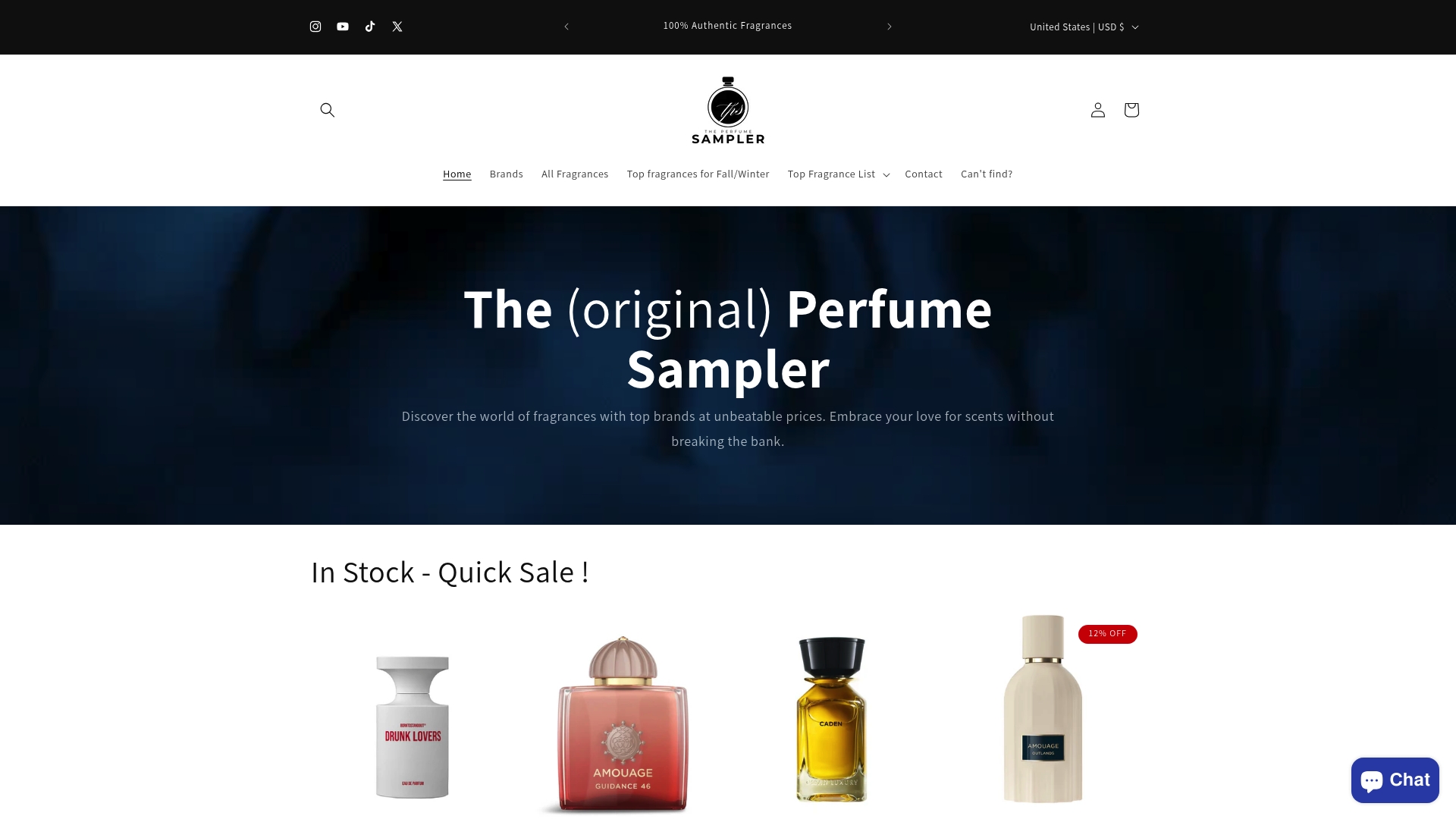
Theperfumesampler offers decants in 2ml, 3ml, 5ml, and 10ml sizes. A 2ml sample is enough for two to three full wear-tests. A 10ml decant gives you enough to test across seasons. Three representative starting points available now:
- Diptyque Paris Orphéon Eau de Parfum: a woody, musky niche release with strong projection and a distinctive dry-down worth testing across multiple days
- BOSS Boss Bottled Absolu Parfum Intense: a designer option with rich base notes, useful for understanding how a structured masculine composition develops on skin
- Born To Stand Out Drunk Lovers Eau de Parfum: a niche release with a distinctive character, a good reference point for gourmand and floral layering experiments
Visit the why decants page to see all available sizes and brands. If you have questions about atelier referrals or bespoke enquiries, the Theperfumesampler customer support team can point you in the right direction.
Recommended
- Discover wearable fragrances: a luxury guide to sampling scents – ThePerfumeSampler
- Discover niche fragrances: unique scents & sampling tips – ThePerfumeSampler
- Explore unique fragrance profiles: niche and affordable sampling – ThePerfumeSampler
- Building a fragrance sample library: your 2026 guide – ThePerfumeSampler