
Start with a 2ml Decant: Test Perfumes for a Sensitive Nose
Yes, most sensitive noses can still wear fragrance if exposure is controlled properly. The safest first step is trying skin-close, low-projection formats in small sample or decant sizes before committing to a full bottle. Check the ingredient list, patch test on skin, and give any new scent 24 to 48 hours before deciding it works for you.
TL;DR:
- Testing fragrance formats like skin scents, oils, and body mists in small doses helps minimize irritation for sensitive noses.
- Applying fragrance to pulse points or clothing can reduce airborne irritation but may affect scent longevity.
- Checking ingredient lists and avoiding common irritants such as parabens, synthetic dyes, and certain essential oils lowers the risk of reactions.
- Using decants for initial testing allows safe, cost-effective assessment before committing to full bottles, especially for those with reactive skin.
- Immediate medical attention is necessary for severe reactions like difficulty breathing or facial swelling, and patch testing is advised for recurrent mild issues.
Table of Contents
- What are the best perfumes for a sensitive nose?
- How do format and application affect irritation risk?
- Which ingredients and label claims should you check?
- How should you safely test a new fragrance?
- When should you stop and see a doctor?
- Why sampling decants makes sense for sensitive noses
- A note on testing patiently
- Try before you commit with decant testing
- Sources
What are the best perfumes for a sensitive nose?
Not every fragrance format carries the same risk. Some sit close to the skin and barely leave a trace in the air; others fill a room within seconds. For a sensitive nose, the format matters as much as the scent itself, and lower airborne intensity often matters more for headaches and nausea than whether the ingredients are labelled “natural” or “synthetic,” according to fragrance experts cited by Who What Wear.
Here are the categories worth trying first, roughly in order of how gentle they tend to be.
-
Skin scents. These are formulated to sit close to the body with minimal throw, meaning almost nobody around you will smell them unless they’re within a foot or two. Soft musks, faint vanilla, and warm skin-like ambers dominate this category. Longevity is often shorter than a traditional spray, so you’ll reapply more often, but that trade-off suits sensitive noses well since each dose is smaller.
-
Oils and solids. Perfume oils and solid balms release scent gradually through body heat rather than through an alcohol-driven spray, cutting down the initial burst that triggers headaches for many people. A green tea or light citrus oil, for example, tends to read as fresh rather than sharp. The downside is that oils can concentrate more strongly on the exact spot applied, so a small patch test matters here too.
-
Eau de toilette and body mists. These sit lower down the concentration scale than eau de parfum or extrait, typically 5 to 15% fragrance oil against 15 to 30% for stronger formulations. A watery floral or light citrus EDT gives you scent without the density of a heavier concentration, and mists dilute things further still.
-
Minimalist or single-molecule fragrances. Complex compositions can carry a dozen or more aroma chemicals stacked together, and any one of them might be your trigger. Fragrances built around one or two dominant molecules reduce that ingredient load, which is often better tolerated by people with airborne sensitivity, per Who What Wear.
Whichever category you start with, try one small sample at a time. Buying five decants and testing them across a single weekend tells you nothing useful if you react. Wear one, wait several days, write down what happened, then move to the next. Green, plant-forward scents in particular can behave unpredictably from one skin type to another, so treat any unfamiliar note family with the same caution.
How do format and application affect irritation risk?
The concentration you choose changes both how strong a scent is and how long it clings to skin or clothing. Body mists are more diluted still, oils and solids release slowly through warmth, and lotions blend fragrance into a moisturising base that spreads scent thinly across a larger skin area.
Where you spray matters just as much as what you spray:
- Pulse points on the wrists or inner elbows keep scent close to you rather than at nose height for others nearby.
- Spraying behind the ears or on the neck puts fragrance directly under your own nostrils, which is the opposite of what an airborne-sensitive person wants.
- Spraying clothing instead of skin can reduce direct skin contact for allergy-prone readers, though scent tends to linger longer and travel further from fabric than from skin.
- Applying to hair should generally be avoided if headaches are a concern, since hair holds fragrance close to the face for hours.
Pro Tip: Instead of one full spray, try two or three light dabs from a decant applicator across the day. Smaller, more frequent doses give you a gentler baseline scent without the concentrated hit of a single heavy application.
Environment plays a role too. Heat intensifies how quickly a fragrance evaporates and how strong it smells, so a scent that feels fine in a cool office can feel overpowering on a hot commute. Poorly ventilated rooms and crowded indoor spaces trap airborne particles, which is exactly where sensitive noses tend to struggle most.
Which ingredients and label claims should you check?
“Hypoallergenic” is not a legally defined term for cosmetics or fragrance in the way many shoppers assume. The FDA notes that the agency cannot require allergen labelling for cosmetics the way it can for food, so a bottle can carry that word on the front while still containing an ingredient that irritates you specifically. The only reliable move is checking the actual ingredient list and contacting the manufacturer directly if anything is unclear.
Certain ingredient classes come up repeatedly in reactions, though none of them affect everyone the same way:
- Parabens and phthalates, used as preservatives and fixatives in some formulations.
- Synthetic dyes added purely for the colour of the liquid.
- Certain essential oil constituents, including some citrus oils that oxidise and become more sensitising over time.
- Heavy white florals (tuberose, gardenia) and dense incense or resin materials, which carry a high concentration of aroma molecules per spray.
None of these are automatic red flags. They’re frequently implicated in reactions, not universally unsafe. Brands that publish full ingredient lists and respond clearly when you ask about allergens give you far more useful information than any front-of-bottle claim. Some hypoallergenic-focused brands genuinely do exclude common irritants and back that up with transparent formulation notes, as seen on pages like Skylar’s sensitive-skin guidance. “Natural” carries the same caveat as “hypoallergenic”: a plant-derived oil can sensitise skin just as readily as a synthetic compound, sometimes more so.
How should you safely test a new fragrance?
A structured test protects you from wasting money on a full bottle that turns out to be a problem, and it protects your skin from a reaction you didn’t see coming. Fragrance industry advice converges on a simple sequence, echoed by Scentake’s testing guidance:
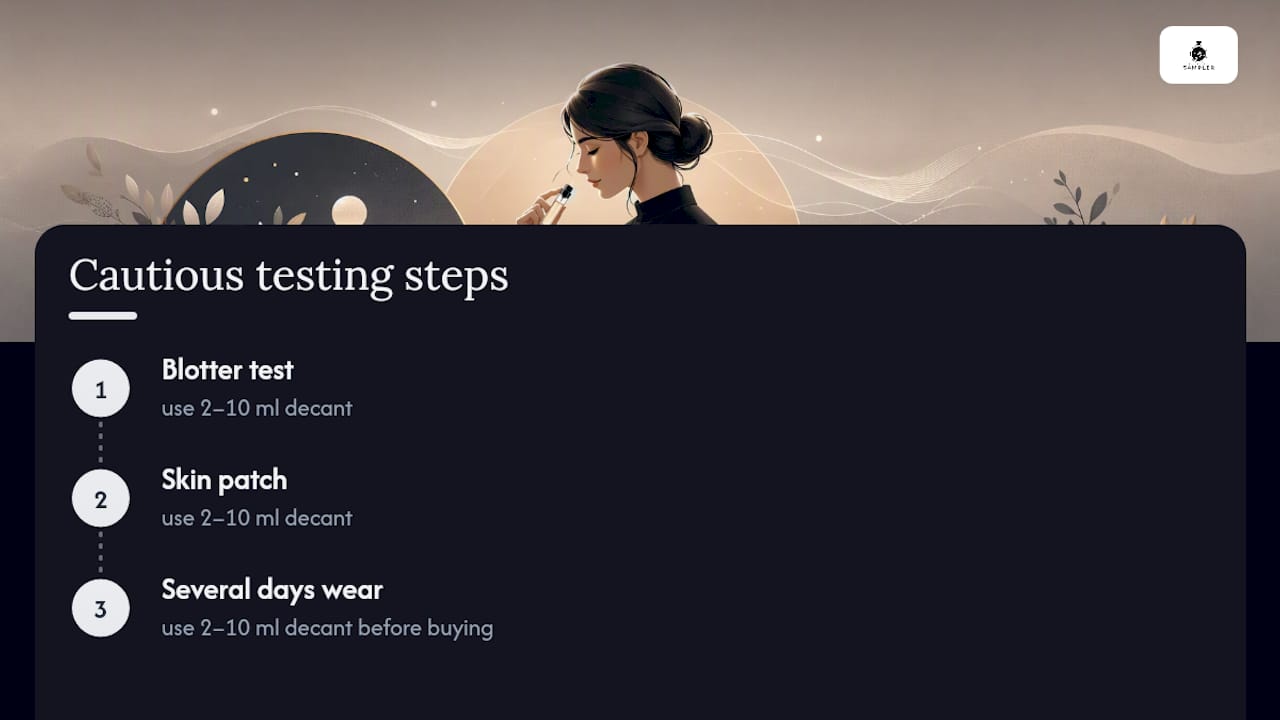
- Spray a blotter strip first, never your skin directly, and smell it in a well-ventilated space rather than at a crowded counter.
- Wait 15 to 30 minutes for the drydown, since the opening notes rarely represent how a fragrance actually smells or behaves once it settles.
- Apply a small skin patch on the inner arm if the blotter stage caused no discomfort, using only a tiny amount.
- Monitor for 24 to 48 hours, watching for redness, itching, or a headache that develops later in the day.
- Test one product at a time. Layering three new samples in a single week makes it impossible to know which one caused a reaction.
If you have asthma or another respiratory condition, speak with a clinician before testing sprays at all, and lean toward oils or solids first, which release far less into the air. Record the batch or lot number if anything goes wrong. You’ll want it if you ever contact the manufacturer or a doctor about the reaction.
When should you stop and see a doctor?
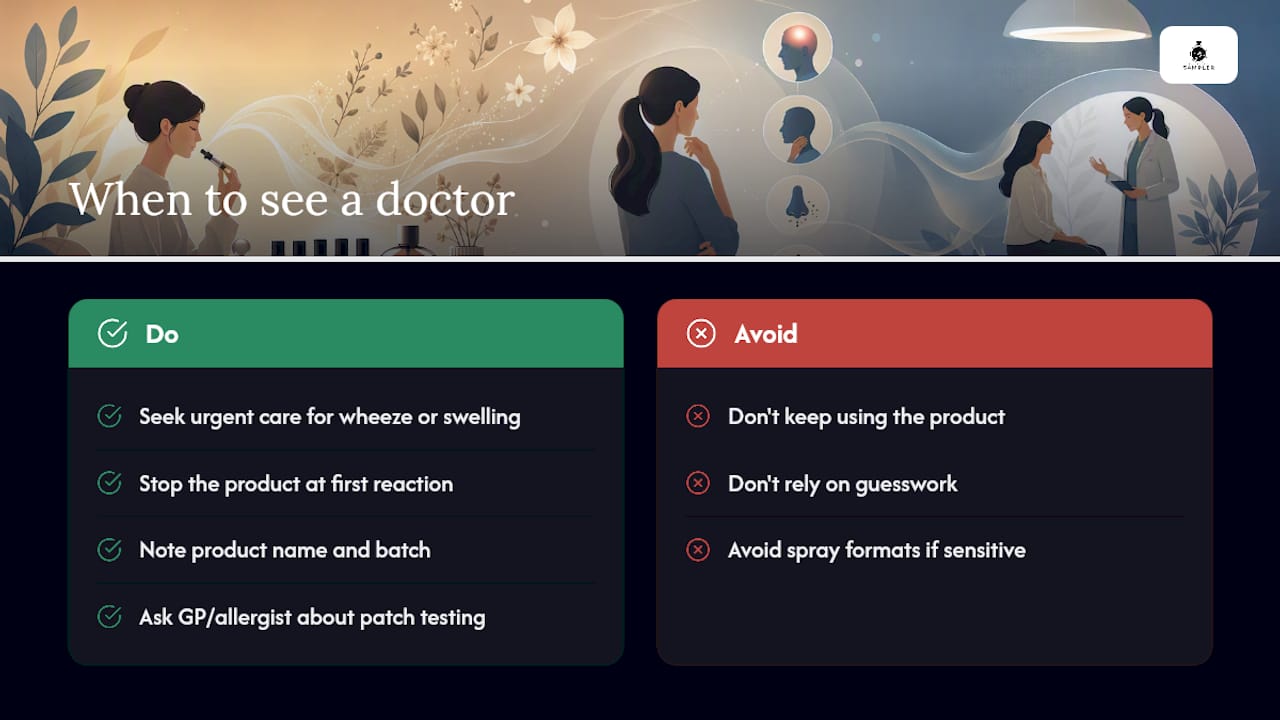
Stop immediately and seek medical attention for wheezing, facial swelling, difficulty breathing, or hives. These signal a reaction serious enough that guesswork stops being appropriate.
For milder but recurring issues, such as a dull headache or persistent sneezing, stop using the product, switch to a non-spray format, and consider asking a GP or allergist about formal patch testing. Keep a note of the product name and batch number for any conversation with a professional.
Why sampling decants makes sense for sensitive noses
Testing new fragrances safely gets expensive fast if every trial means buying a full bottle. Theperfumesampler supplies decants in 2ml, 3ml, 5ml, and 10ml sizes specifically so readers can run a blotter test, a skin patch, and a few days of real-world wear without paying full-bottle prices for something that might not suit them.
Rupesh, a contributor on the Theperfumesampler blog, has built a body of curated fragrance recommendations aimed at exactly this kind of cautious, incremental approach. Sampling in small quantities also cuts waste: if a scent triggers a reaction, you’ve lost a few millilitres rather than an entire bottle sitting unused in a drawer.
A note on testing patiently
I keep a short list of scents I know my skin tolerates, and I add to it slowly, one small decant at a time. There’s no shame in skipping sprays altogether if oils or solids treat you better. Patience and a notebook do more for a sensitive nose than any bottle claiming to be safe for everyone.
— Rupesh
Try before you commit with decant testing
Full-bottle prices punish exactly the caution a sensitive nose needs. Theperfumesampler solves that by selling decants in 2ml, 3ml, 5ml, and 10ml sizes, so you can run a proper blotter and skin patch test on a handful of fragrances for a fraction of what one full bottle would cost.
Start with a 2ml decant for the blotter stage, move to skin only once that’s clear, and read the why decants page for a fuller breakdown of how the sizing works. If a scent passes your 48 hour check and you want to go further, a fragrance like the Boss Bottled Absolu Parfum Intense shows what a full-bottle purchase looks like once you’re confident in your choice. Sensitive skin readers exploring essential oil alternatives may also want to look at Wellthious’s essential oil range for dilution guidance alongside perfume testing. Browse the decant sizes and pick one scent to trial this week.
Sources
- Fragrances in cosmetics | FDA
- How to choose perfume for sensitive noses without giving up scent
- The 15 Best Perfumes for Sensitive Noses | Who What Wear
- Perfume for sensitive skin | Hypoallergenic scents