
Sample First Office Safe Niche Perfumes: 5ml Decant Test
The most reliable way to wear niche perfume at work is to choose minimal, skin-close compositions and test them in small decants before buying a full bottle. Subtlety comes from the formula, not the brand name on the box. This guide covers the ingredient signals to look for, a practical sample-first testing routine, office etiquette, and a rotation plan that keeps a work wardrobe interesting without ever overwhelming the room.
TL;DR:
- Minimal, skin-close niche perfumes with synthetic musks, cetalox, or ionones tend to produce low projection suitable for office environments.
- Testing fragrances on skin for four to six hours in typical office conditions is essential to gauge true longevity and projection.
- A five-milliliter decant allows for a full week of daily tests, making it easier to build a rotation and avoid overcommitting to a full bottle prematurely.
- Fragrance application should follow the three-foot rule, with one or two light sprays on pulse points, and avoid spraying near shared spaces or food areas.
- Office-appropriate fragrances fall into categories like clean musks, powdery florals, citrus teas, and soft woody vanillas, with stronger Oriental or gourmand scents generally unsuitable.
Table of Contents
- What makes office safe niche perfumes actually work
- Fragrance families and profiles worth trying first
- How to test niche perfumes before committing
- Application rules: the three-foot guideline and where to spray
- Building a five-day rotation from samples
- Keeping niche scent alive through an eight-hour day
- Fragrance sensitivities and shared workspace etiquette
- Matching a niche scent to your role and office culture
- Author perspective: subtlety is the harder skill in niche perfumery
- Try office-safe niche fragrances risk-free with small decants
- Sources
- FAQ
What makes office safe niche perfumes actually work
The technical answer sits in two words: sillage and concentration. Sillage is the scent trail a fragrance leaves behind as you move, and office-appropriate perfumes need low to moderate sillage) so they’re detectable only at close range, not from across a meeting room. Concentration matters here too. An eau de toilette (EDT) typically carries less oil and diffuses faster than an eau de parfum (EDP), which makes EDTs the safer default for open-plan offices, though a well-built EDP applied sparingly can work just as well.
What separates a “loud” fragrance from a quiet one usually comes down to raw materials, not strength alone. Minimalist niche formulas often lean on softer aroma materials that sit close to the skin rather than radiating outward. Look for these on a brand’s note list or in blog descriptions:
- Synthetic musks — clean, laundry-like, and famously low projection.
- Cetalox (ambroxan) — a warm, skin-like amber note used to add depth without volume.
- Ionones — powdery, violet-adjacent molecules that soften a composition instead of sharpening it.
- Salicylates — sunscreen-like, slightly sweet notes that add roundness with minimal throw.
- Light woods — cedar, sandalwood, and vetiver in restrained doses rather than dense, resinous bases.
Avoid the opposite end of the spectrum: oud-heavy orientals, dense amber resins, potent animalics such as civet or heavy castoreum accords, and sugary gourmands built on caramel or praline. These are built to project for hours, which is exactly what a shared workspace doesn’t need. If your office runs cold in winter and warm in summer, adjust accordingly. Heat amplifies sillage, so a scent that felt perfectly restrained in December can read as heavier in July. A desk near a vent or a window seat in direct sun will also intensify a fragrance faster than a shaded corner.
Fragrance families and profiles worth trying first
Four scent categories consistently perform well in professional settings, according to editorial guidance on office-appropriate perfumes. None of these require a specific brand. Treat them as profiles to look for when browsing niche houses or reading sample descriptions.
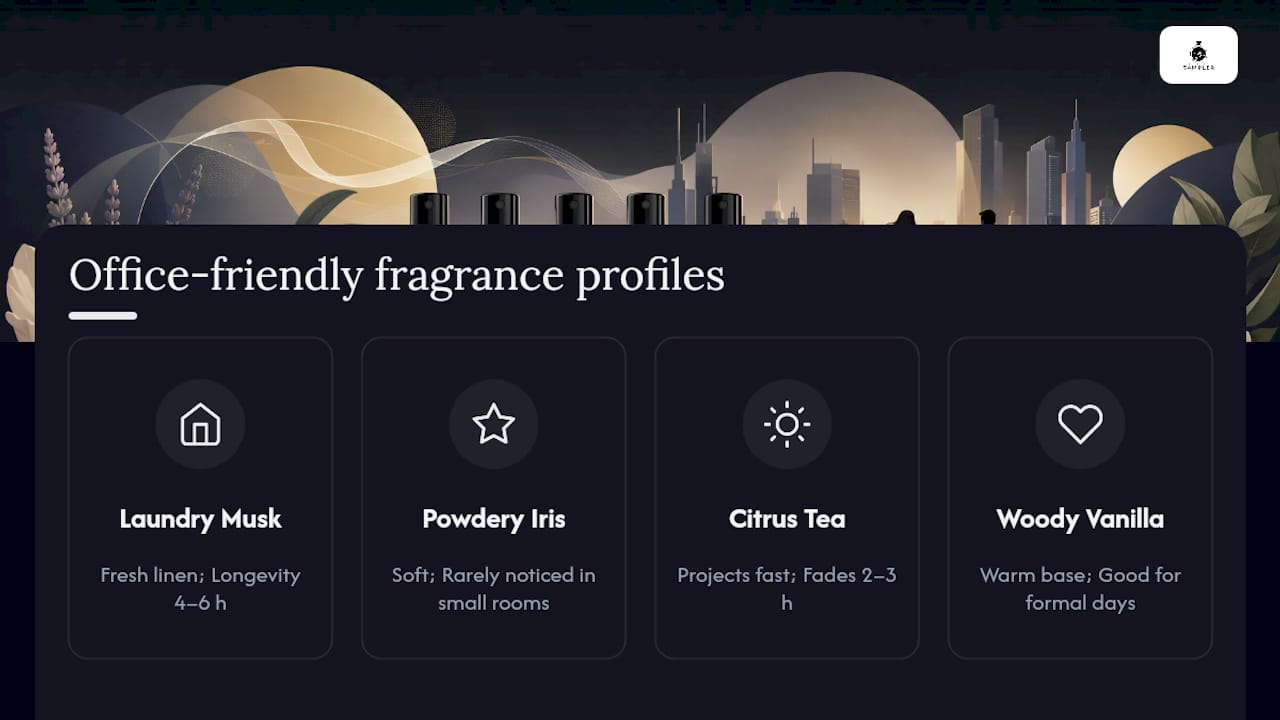
Clean cotton and laundry musks. These read as freshly washed linen rather than perfume. Longevity tends to be moderate (four to six hours on skin), and they work well for early meetings or client calls where you want to seem put-together without seeming scented at all.
Powdery iris and ionone-led compositions. Iris and violet-leaf notes create a soft, cosmetic quality, similar to the inside of a makeup compact. Powdery florals sit among the categories editors return to for professional wear because they perform consistently across genders and rarely trigger the “who’s wearing perfume?” question in a small conference room.
Citrus and tea aromatics. Bergamot, yuzu, and green or white tea accords project fast but fade fast too, often within two to three hours. That makes them ideal for morning wear with a planned midday touch-up, rather than an all-day single application.
Soft woody musks and lactonic vanils. A gentle sandalwood or cashmeran base paired with a creamy, milky vanilla (not a sugary one) gives warmth for formal days, presentations, or dinners immediately after work, without tipping into gourmand territory.
Pro Tip: Iso E Super deserves a special mention. Certain synthetic molecules, including Iso E Super and cetalox, are used specifically to create subtle, skin-like, long-lasting effects in minimalist niche work. If a fragrance description mentions either, it’s usually a strong sign the composition was built with restraint in mind.
How to test niche perfumes before committing
Sniffing a strip in a shop tells you almost nothing about how a fragrance will behave on your skin for eight hours under office lighting and central heating. Skin chemistry, body temperature, and even what you ate for lunch all shape how a scent evolves, which is why testing on skin over several hours is necessary to judge office suitability rather than relying on a first impression.
A proper testing routine looks like this:
- Apply a single spray to your inner wrist or forearm, never more, and note the time.
- Wear it for four to six hours through a normal working stretch, ideally at your desk rather than at home, since office air conditioning and proximity to colleagues change how a scent reads.
- Check projection at intervals — immediately, at one hour, at three hours, and again at six hours — to see whether it fades gracefully or turns sharp as it dries down.
- Repeat on a second day wearing it on a different pulse point (behind the ear or on the collarbone) to compare how location affects diffusion.
- Note colleague feedback, if it comes up naturally. Nobody should have to ask what you’re wearing, but if someone mentions it unprompted and positively, that’s a useful data point.
This is exactly why small decants make more sense than full bottles for this stage — Pure Parfum EU offers curated product sets and sample bundles perfect for trying multiple small-format fragrances before buying a full bottle. Two to ten millilitre sizes give you enough product for a full week of wear tests without the £150 to £300 commitment of a full bottle, and they take up almost no drawer space if you want to keep several profiles in rotation. The benefits of sample-size fragrance testing extend beyond cost. Carrying a 5ml decant in a desk drawer also means you can layer or swap scents without hauling a full bottle to the office.
Pro Tip: Run a blind rotation for two weeks. Wear a different sample each day without telling anyone which fragrance is which, then ask a trusted colleague at the end of the fortnight which days they noticed a scent at all. The days nobody noticed are usually your safest long-term picks.
Application rules: the three-foot guideline and where to spray
How much you apply matters more than what you apply. Workplace etiquette guidance consistently points to the “three-foot rule”: your fragrance should generally be detectable only within about three feet of you, not from across a desk or down a corridor. One or two light spritzes, applied correctly, achieves this for almost any composition.
Follow this quick sequence before leaving home:
- Spray once on each wrist, or once on the chest if you prefer a slower reveal through body heat.
- Never spray in a shared bathroom or break room, where the scent lingers for others long after you’ve left.
- Avoid spraying anywhere near shared food or coffee stations, since fragrance and food smells clash badly in enclosed spaces.
- Test the three-foot rule yourself: spray, wait 60 seconds, then ask a family member or flatmate to stand three feet away and tell you honestly whether they can smell it.
- Have a colleague-sensitivity checklist in mind: if your office has a fragrance-free policy or someone nearby has a known sensitivity, switch to an unscented alternative that day rather than testing the boundary.
For particularly scent-sensitive workplaces, scented body lotions, hair mists, or roll-on oils give a whisper of fragrance at true skin-contact range without any spray radius at all. They’re a sensible fallback rather than a downgrade.
Building a five-day rotation from samples
A curated rotation beats a single “signature scent” for office wear, mainly because it keeps any one fragrance from becoming so familiar to colleagues that they start noticing its absence, or worse, its overuse. Structure it around the working week rather than the calendar:
- Monday and Tuesday: clean cotton or laundry musk, for the quieter, task-focused start to the week.
- Wednesday: citrus or tea aromatic, timed for a midweek energy lift and reapplied lightly after lunch if needed.
- Thursday: powdery iris or ionone-led profile, suited to client meetings or presentations.
- Friday: soft woody musk or lactonic vanilla, if the day runs into evening plans.
Keep two or three 5ml decants in a desk drawer rather than a full bottle collection. It’s easier to grab the right one without a spillage risk, and layering a citrus top note over a musk base on a warmer day takes seconds once the samples are within reach. Our guide to refreshing work fragrances covers midday top-up techniques that don’t require reapplying from scratch.
Move from sample to full bottle only once a scent has passed a genuine test: consistent performance across several wear tests, no negative or surprised reactions from colleagues, and a cost-per-wear that justifies the investment. Our workplace perfume selection guide walks through that decision in more detail.
Keeping niche scent alive through an eight-hour day
Longevity in an office setting isn’t really about the fragrance formula alone. It’s about air conditioning, dry skin, and hours spent typing at a desk rather than moving around, all of which speed up how fast a scent fades.
Moisturised skin holds fragrance noticeably longer than dry skin, so applying an unscented body lotion before your spray gives the scent something to cling to. Pulse points still work (wrists, inside elbows, base of the throat) but layering matters more than location. A single spray on moisturised skin will often outlast three sprays on dry skin.
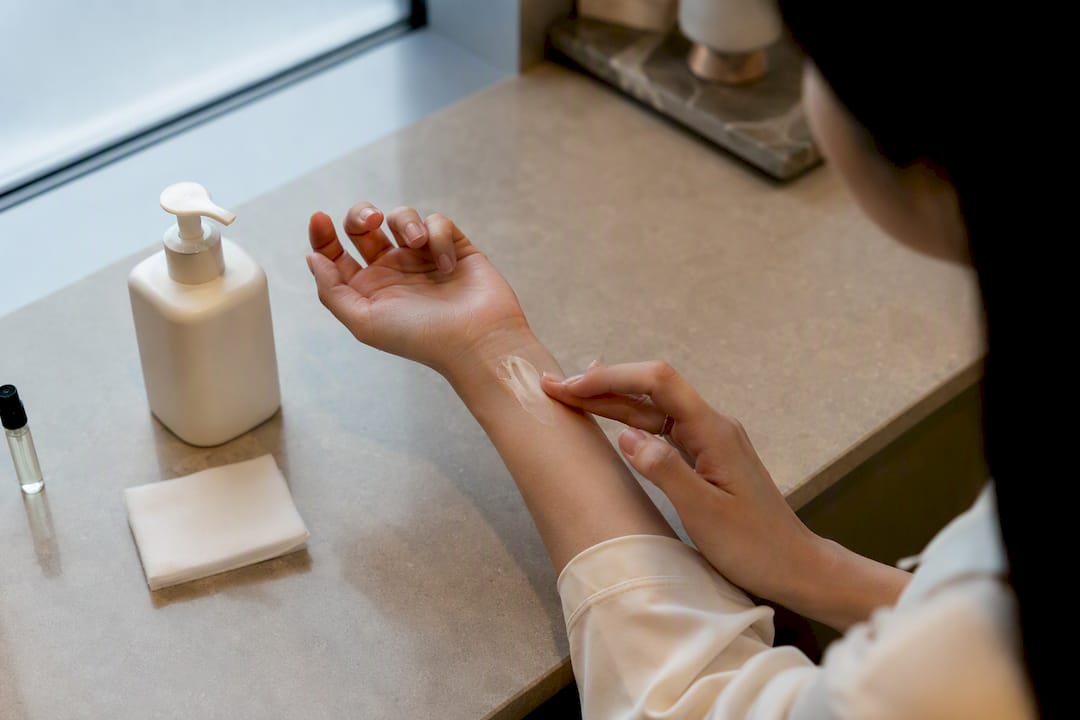
Carry your decant rather than relying on a single morning application to last the whole day. A light top-up spray after lunch, applied to the same spot as the morning application, extends wear without creating a sudden new burst of scent that colleagues will register as “new perfume smell.” Reapplying to clothing rather than skin can also help, since fabric holds fragrance oils longer than skin does, though it’s worth checking that delicate or pale fabrics won’t stain.
Store your decant somewhere cool and out of direct light, even at your desk. Heat and UV exposure degrade fragrance oils faster than most people realise, which shortens both shelf life and the scent’s performance on skin over a working day.
Fragrance sensitivities and shared workspace etiquette
Open-plan offices concentrate more people into less air volume than almost any other shared environment, which is exactly why fragrance sensitivity has become a real workplace consideration rather than a minor preference. Some colleagues experience genuine physical reactions, headaches, respiratory irritation, or migraines, triggered by strong fragrance in enclosed spaces, not just personal dislike of a particular scent.
This is worth taking seriously rather than treating as oversensitivity. If your workplace has a formal fragrance-free or low-fragrance policy, it typically exists because someone has raised a genuine health concern, and it applies to niche perfume exactly as much as it applies to drugstore body spray. Concentration and price don’t make a fragrance exempt from causing a reaction.
Where no formal policy exists, the safest approach is still restraint by default: single sprays, skin-close compositions, and the willingness to switch to an unscented alternative if a colleague mentions a sensitivity directly. Shared meeting rooms and lift lobbies deserve extra caution, since they concentrate scent in a way open desks don’t. If you share a small office or sit near an air vent that circulates directly to a colleague’s desk, it’s worth asking rather than assuming your usual application is fine.
Matching a niche scent to your role and office culture
A trading floor and a design studio don’t call for the same fragrance, even if both technically qualify as “office-safe.” Role and culture shape what reads as appropriate far more than most fragrance guides acknowledge.
Client-facing and formal roles (law, finance, consulting) generally suit the more restrained end of the spectrum: clean musks, powdery iris, or soft woody bases that project minimally and read as polished rather than memorable. The goal in these settings is usually to not be noticed for your fragrance at all.
Creative and design-led workplaces often tolerate, and sometimes reward, a slightly more distinctive profile, provided sillage stays low. A soft woody-musk with an unusual accord (a hint of fig, or a green tea note) can register as personality without breaking projection rules.
Hybrid and mostly remote roles with occasional in-office days give more room to experiment, since you’re not wearing the same scent daily in front of the same people. This is actually the easiest scenario for building a genuinely varied niche rotation, since fatigue and overexposure are less of a risk.
Whatever the role, err toward the quieter option when in doubt. A fragrance that’s slightly too subtle is a non-issue. One that’s slightly too loud is a conversation people have about you once you’ve left the room.
Author perspective: subtlety is the harder skill in niche perfumery
Most people assume “niche” means bold, and it’s the opposite that actually works at a desk. The best minimalist formulas take real skill to build, since restraint is far harder to engineer than volume. Sample generously, rotate often, and give colleagues the courtesy of never having to think about what you’re wearing.
— Rupesh
Try office-safe niche fragrances risk-free with small decants
Buying a full bottle to find out whether a fragrance behaves at your desk is an expensive way to learn a lesson a 2ml decant can teach you for a fraction of the price. Small decants in 2ml, 3ml, 5ml, and 10ml sizes are ideal for running the wear tests covered above before committing to anything larger.
A 5ml decant covers a full working week of single-spray tests, which makes it the practical size for building the kind of rotation described earlier in this guide. If you’re new to sampling, our page on why decants make sense explains the reasoning in more depth. Once a scent earns its place in your weekly rotation through genuine testing, you can move to a full bottle with confidence instead of guesswork. Browse the full fragrance catalogue to start building your own office-safe shortlist, one decant at a time.
Sources
- 6 Best Perfumes for a Subtle Fragrance — The Strategist (NYMag)
- 10 ‘smart’ office-appropriate perfumes to make you feel polished and put-together — Harper’s Bazaar
FAQ
What are some safe fragrances for the office?
Clean musks, powdery iris compositions, light citrus-tea aromatics, and soft woody-musk bases are consistently the safest choices, since they favour low sillage and skin-close projection over strong, room-filling trails.
What are some good office-friendly perfumes?
Rather than a single brand, look for niche formulas built around cetalox, ionones, or synthetic musks, all of which are commonly used to create subtle, second-skin effects suited to shared workspaces.
What is the best perfume for office use?
There’s no single best option since skin chemistry changes how any fragrance performs, which is why testing a small decant for several hours on your own skin matters more than any single recommendation.
What is the best scent for office?
Powdery, clean, and lightly woody profiles tend to perform best across genders and office cultures, while oud, heavy gourmands, and strong animalics are best reserved for evenings outside the workplace.