
Musk fragrance exploration: a hands-on guide for enthusiasts
The quickest, repeatable method for exploring musk fragrances is this: run short, focused sampling sessions using 4–6 reference decants covering the main musk families, timed blotter and skin checks, and a compact sensory checklist. Within a single 1–2 hour session, you can reliably distinguish clean musks from animalic ones and identify which family suits you. Your minimum kit is straightforward:
- 4–6 decants in 2–5 ml sizes (covering clean, skin, powdery and animalic musk types)
- Blotter strips and a timer
- Notebook or phone for notes
- Coffee beans or plain water for olfactory resets between samples
Musk appears as a base note in 83% of the fragrances in which it is listed, functioning as a fixative that warms and extends other notes. Molecules such as galaxolide (soapy, clean) and muscone (animalic, skin-like) represent opposite ends of the spectrum and make ideal reference points when you start. Theperfumesampler’s 2 ml, 3 ml, 5 ml and 10 ml decants are sized precisely for this kind of structured musk fragrance exploration.
Table of Contents
- Why some people cannot smell certain musks
- A step-by-step musk sampling method you can run at home
- Key takeaways
- The part of musk exploration most guides skip
- Build your musk exploration kit with Theperfumesampler
- Useful sources for further reading
Why some people cannot smell certain musks
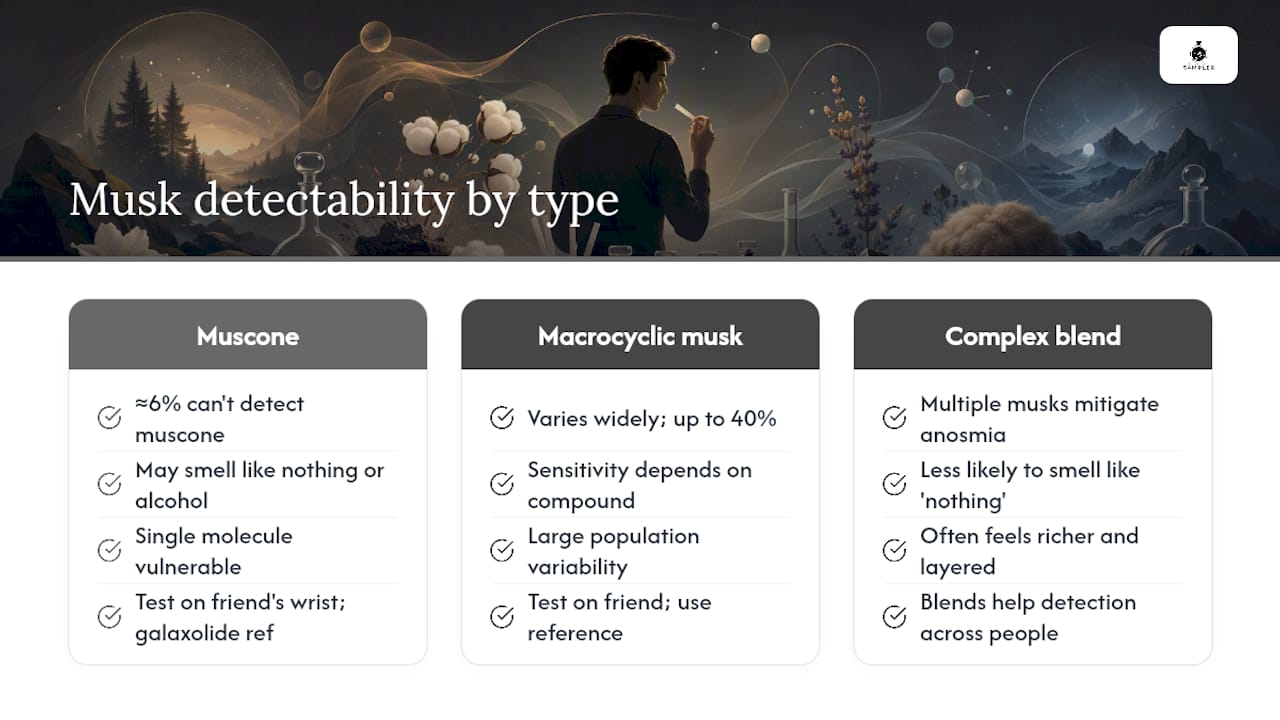
Specific anosmia to musk molecules is one of the most documented examples of genetic variation in human smell perception. Olfactory receptors OR4D6 and OR5A2 are among those implicated in musk detection, and their expression varies significantly between individuals.
Research summaries on musk anosmia indicate that around 6% of people cannot detect muscone, while sensitivity to some macrocyclic musks varies far more widely across populations, with some studies citing figures as high as 40% for specific compounds. These are not rare edge cases.
The practical implication: if a musk-heavy fragrance smells “like nothing” or “just alcohol” to you on first sniff, you may have a specific anosmia to its dominant musk molecule rather than a problem with your testing method. Blends that use multiple musk types mitigate this, because even if one molecule is invisible to you, others in the blend will register. This is one reason complex musk compositions often feel richer than single-molecule musks.
Pro Tip: If you suspect an anosmia, test the same fragrance on a friend’s wrist alongside your own. If they detect a clear musk character and you do not, the gap is perceptual, not methodological. Cross-reference with a known clean musk reference (galaxolide-dominant) to confirm your baseline.
Understanding why scents smell different on different people is directly relevant here, and Theperfumesampler’s guide on fragrance variation covers the skin chemistry side of this in detail.
A step-by-step musk sampling method you can run at home
This is a repeatable protocol. Follow it in order and your results will be consistent across sessions.
Preparation
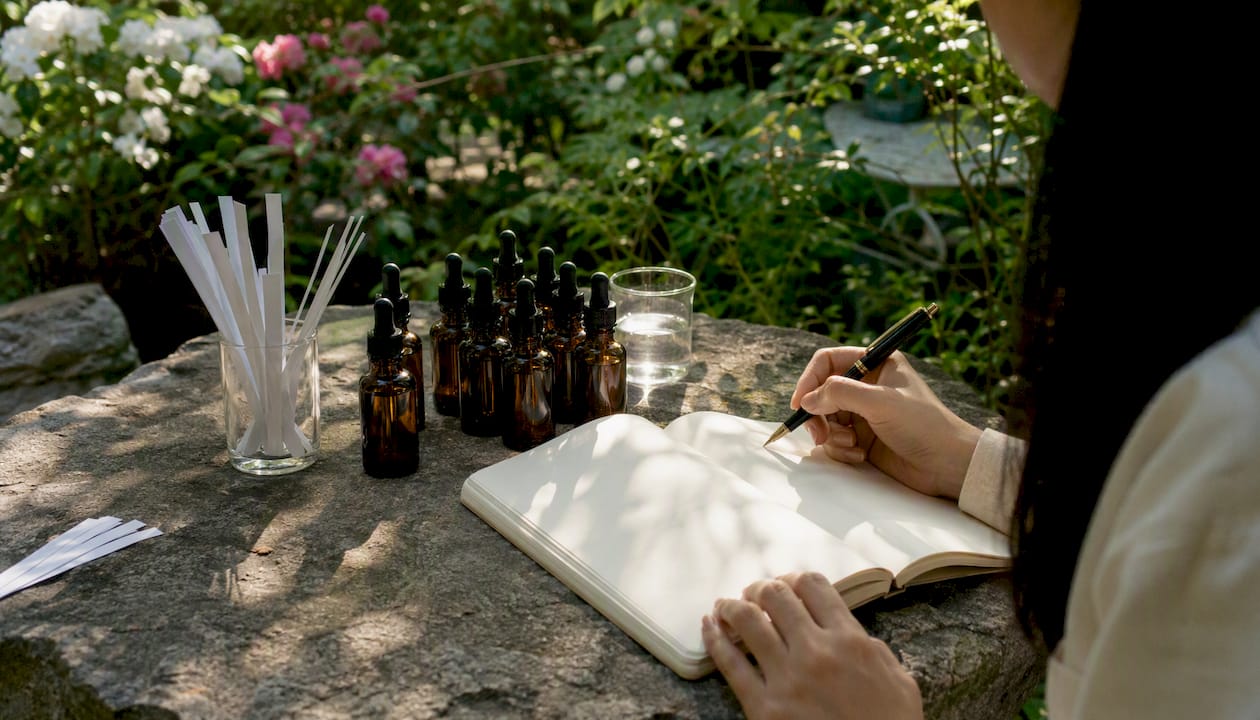
Assemble 4–6 decants covering at least three musk families. Choose a neutral environment: no strong food smells, no scented candles. Have blotter strips, a glass of water, and plain crackers or coffee beans to hand. Use reference scents as anchors — one known clean musk and one known animalic musk give you the two poles of the spectrum.
The testing sequence
- Spray or dab each sample onto a labelled blotter. Smell immediately and note the opening character in one or two words.
- Set a 15-minute timer. During this period, do not re-smell. Reset your nose with water or coffee beans between blotters.
- At 15–30 minutes, smell each blotter again. The alcohol has largely evaporated. Note any shift in character.
- Apply your two or three strongest candidates to skin — one per wrist or forearm. Label each spot.
- At 1 hour, smell each skin application. Note warmth, texture, projection and any change from the blotter impression.
- At 3–4 hours, return for the dry-down check. This is where macrocyclic and animalic musks distinguish themselves most clearly.
Timing checkpoint table
| Time | What to assess |
|---|---|
| immediate (blotter) | Opening character, dominant impression |
| 15–30 min (blotter) | Alcohol-off profile, first musk reveal |
| 1 hour (skin) | Warmth, texture, projection, note evolution |
| 3–4 hours (skin) | Dry-down, longevity, skin-meld quality |
Recordkeeping
For each sample, note: opening, heart, dry-down, texture (powdery/watery/creamy), projection (close/moderate/loud), longevity estimate, and your emotional reaction in one word. A simple 1–5 score for each attribute is enough to build a personal map over time. Living with a musk-forward scent for a full day is one of the most effective ways to understand its full profile.
Pro Tip: Limit yourself to 4–6 samples per session. Olfactory fatigue sets in quickly with musks because they are diffuse and low-projection. Space sessions by at least 24 hours for reliable cross-session comparisons.
Key takeaways
A structured musk sampling session using timed blotter and skin checks, reference decants across four to five musk families, and brief dated notes produces reliable personal preferences within two to three sessions.
| Point | Details |
|---|---|
| Session size limit | Test 4–6 samples per session to avoid olfactory fatigue and keep results reliable. |
| Timing checkpoints | Smell immediately, then at 15–30 min, 1 hour and 3–4 hours to capture the full dry-down arc. |
| Anosmia awareness | Around 6% of people cannot detect muscone; blends using multiple musk types reduce this risk. |
| Sensory checklist | Note texture, warmth, cleanliness, powder, longevity and projection for each sample. |
| Theperfumesampler | Offers 2 ml, 3 ml, 5 ml and 10 ml decants across niche and designer musks for affordable repeat testing. |
The part of musk exploration most guides skip
Disciplined sampling changed how I think about fragrance purchasing. Before running structured sessions, I bought full bottles based on first impressions, often finding that a fragrance I loved in a shop smelled flat or one-dimensional after a week of wear. The method described here, particularly the 3–4 hour dry-down check, revealed that the musks I actually preferred were the ones that became more interesting over time, not the ones that opened loudly and faded.
The conventional advice is to “trust your nose.” That is true, but incomplete. Your nose needs reference points, timing, and a record to trust. Without those, you are comparing impressions from different days, different skin conditions, and different moods. The sensory checklist and timed protocol are not bureaucratic additions to the experience. They are what make the experience legible.
One point that rarely appears in musk guides: the anosmia issue is not a problem to solve. It is information. If you cannot detect a particular musk molecule, that tells you something about which fragrance families will consistently reward you and which will always feel thin. That is genuinely useful data for a fragrance collection.
Build your musk exploration kit with Theperfumesampler
Theperfumesampler offers a practical, cost-effective way to run this method in the UK. Rather than spending on full bottles of fragrances you may not connect with, you can assemble a focused musk sampling rotation using individual decants in 2 ml, 3 ml, 5 ml and 10 ml sizes, covering clean, skin, powdery and animalic musk profiles.
A suggested starter rotation for this method: four 3 ml decants, one from each of the main musk archetypes (clean, second-skin, animalic, powdery). That gives you enough material for two full sessions, including the 4-hour dry-down checks, at a fraction of the cost of a single full bottle. All fragrances are 100% authentic, and UK shipping is available across the range.
Visit Theperfumesampler to browse the current musk-forward decant selection and build your first sampling rotation.
Useful sources for further reading
- Musk — The Sniff Test
- How to identify a natural musk smell in perfume
- What does a genuine musk perfume actually smell like?
- How to layer musk fragrances right — PerfumeOnSkin
- Musk in perfumery: the definitive 2026 note guide — Scent Chronicles
- History of the musk industry — Sedr Al Khaleej
- The role of musk in fragrance: a complete guide — The Perfume Sampler