
How to enjoy niche sampler sets: a practical guide
Enjoying a niche sampler set means testing a few scents at a time, wearing them on skin across their full dry-down, and logging reactions — not sniffing everything at once. The simplest repeatable routine: unbox, prep your skin, do a quick blotter pass to eliminate obvious mismatches, shortlist two candidates, wear one or two on skin, then log impressions at 30, 120, and 240 minutes. Re-test your favourites the next day before deciding.
Quick-start checklist:
- Unbox and label every vial before you start
- Prep skin: unscented moisturiser, no competing fragrance
- Blotter pass: one spray per strip, mark each strip with the name
- Shortlist two scents that pass the blotter stage
- Apply one or two on skin (pulse points only)
- Log impressions at 30 min, 2 hours, and 4 hours
- Re-test your top picks on a separate day before buying
Pro Tip: Between samples, step outside for 30 seconds of neutral air or hold unscented fabric to your nose. Coffee grounds do not reset the nose reliably; fresh air does.
Small fragrance decants in the 2ml–5ml range give you enough product for realistic skin wear without committing to a full bottle. A 5ml decant typically yields 50–70 sprays, which is enough for several full-day wears. That volume is what separates a genuine evaluation from a rushed sniff.
Key takeaways
Testing a limited number of scents per session on skin, logging impressions at consistent timepoints, and re-testing finalists before buying is the most reliable way to get genuine value from a niche sampler set.
| Point | Details |
|---|---|
| Limit sessions to two scents | Testing more than two per day causes nose fatigue and produces unreliable impressions. |
| Skin beats paper for final decisions | Blotters eliminate obvious mismatches; skin chemistry determines how a scent actually develops on you. |
| Log at three timepoints | Note impressions at 30 minutes, 2 hours, and 4 hours to capture top, heart, and base notes accurately. |
| Store samples correctly | Keep vials upright in a cool, dark place; opened samples remain reliable for 2–6 months under good conditions. |
| Theperfumesampler decants fit every stage | 2ml–5ml decants cover initial testing; 5ml–10ml sizes suit extended evaluation before a full-bottle purchase. |
Table of Contents
- How to enjoy niche sampler sets: a step-by-step testing routine
- What fragrance structure tells you about each sample
- How to pace sessions and avoid nose fatigue
- How to apply samples correctly for accurate results
- How to evaluate a sample and keep a useful scent journal
- How to store sampler vials so they stay reliable
- How to choose the right sampler set for your goals
- Theperfumesampler’s size guide for testing and wearing
- Why sampling changes how you buy fragrance
- Try decants before committing to a full bottle
- Sources
How to enjoy niche sampler sets: a step-by-step testing routine
A reliable routine follows this sequence: blotter pass, shortlist, skin wear, scheduled notes, re-test. Follow it consistently and you will have comparable data across every vial in your set.
Step-by-step:
- Set your goal. Decide what occasion or season you are shopping for before you open a single vial. A summer office scent and a winter evening fragrance need different evaluations.
- Prep your skin. Apply a thin layer of unscented moisturiser to your inner wrists and inner elbows. Dry, unhydrated skin shortens longevity and skews your reading.
- Blotter pass. Spray or dab each sample onto a labelled strip. Wait 60 seconds, then smell. Anything that causes immediate discomfort goes straight to the discard pile. This stage is for quick eliminations only.
- Shortlist. Select the two strips that interest you most. Put the rest aside for another session.
- Skin application. Apply one shortlisted scent to the left inner elbow and the second to the right. One or two sprays per site is sufficient for a 2ml–5ml decant.
- Scheduled check-ins. Note impressions at 30–60 minutes (heart notes emerging), 2 hours (heart fully open), and 4 hours (base and dry-down). Record what changes and what stays constant.
- Re-test. Before any purchase decision, wear each finalist on a separate day. Skin chemistry, diet, and even stress levels affect how a scent develops.
Structured discovery routines consistently produce better long-term matches than blind buys, with many shoppers reaching clarity after testing five to eight scents.
How many samples per day? Two is the practical maximum for accurate impressions. Three is possible if you space them across morning and afternoon. Testing more than that in a single session produces unreliable results.
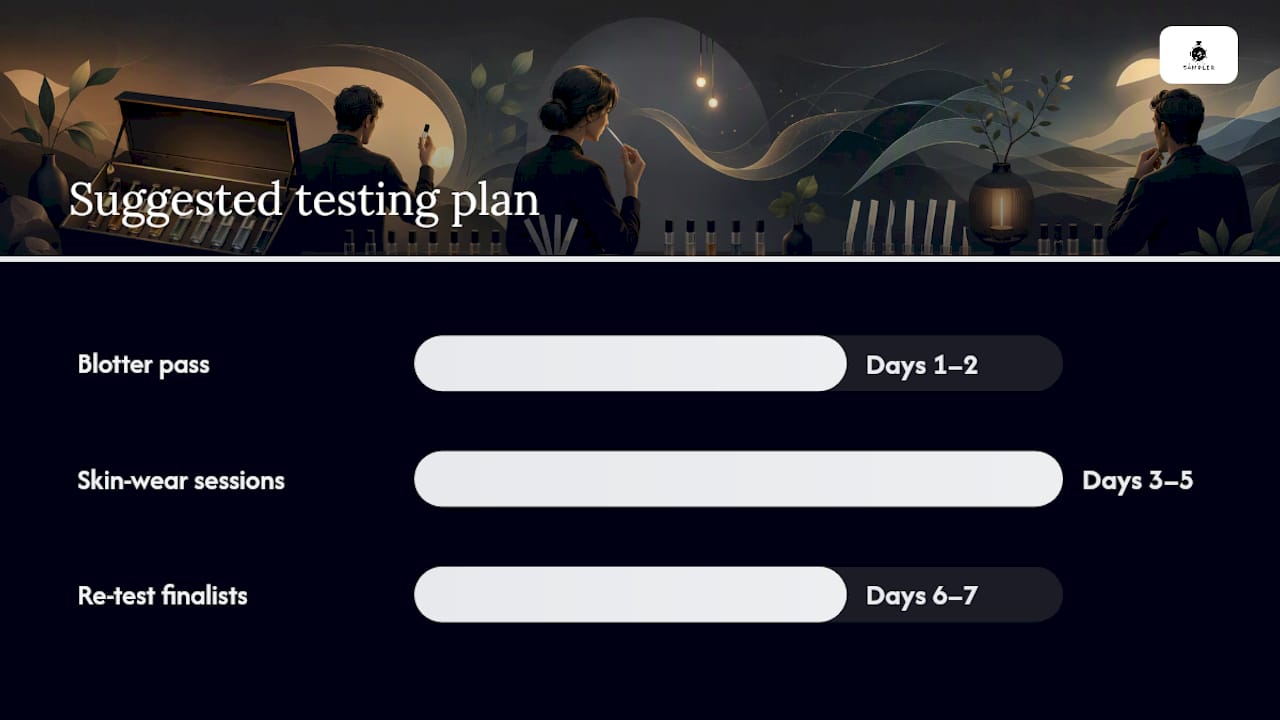
Suggested plan for a 5–10 vial set:
- Days 1–2: blotter pass across all vials, shortlist four to six
- Days 3–5: skin-wear sessions, two scents per day
- Days 6–7: re-test your top two or three finalists
Pro Tip: Spray a shortlisted scent on a cotton scarf or the inside of a collar to check longevity without adding another layer to your skin. Fabric holds base notes for hours and gives a useful secondary read.
What fragrance structure tells you about each sample
A sample’s true character is its heart and base on your skin, not the opening burst on a blotter. Top notes evaporate within 5–15 minutes. Judging a scent at that stage is like judging a meal by the smell of the pan.
Key terms to know:
- Top notes: the first impression, lasting 5–15 minutes; often citrus, light herbs, or aldehydes
- Heart (middle) notes: the core of the fragrance, emerging at 20–60 minutes; florals, spices, and green accords dominate here
- Base notes: the foundation, appearing after 1–2 hours; woods, musks, resins, and ambers
- Dry-down: the full evolution of a scent on your skin from application to base
- Sillage: how far the scent projects from the skin into the surrounding air
- Projection: how strongly the scent radiates at close range
- Longevity: total hours the scent remains detectable on skin
- Concentration: EDP (Eau de Parfum) typically lasts 6–8 hours; Parfum lasts 8–12 hours; EDT lasts 3–5 hours
Concentration matters for decant evaluation. A 2ml EDP sample gives you fewer sprays than a 2ml EDT, but each spray delivers more fragrance. Adjust your spray count accordingly so you are not depleting a small vial in one wear.
Mapping samples to scent families speeds up comparisons. The main families are citrus, floral, woody, amber/gourmand, fougère, and chypre. If you already know you prefer woody ambers, you can fast-track those vials to skin testing and spend less time on florals at the blotter stage.
How to pace sessions and avoid nose fatigue
Spacing and limits prevent fatigue. Test a maximum of two scents per session and rest your nose between sessions. Nose fatigue is cumulative: the more you smell in one sitting, the less accurately you perceive each subsequent scent.
Practical session formats:
- Micro session (30–60 minutes): blotter pass only; useful for quick eliminations at the start of a new set
- Full session (4–8 hours): one or two scents on skin with scheduled check-ins; the only format that gives you reliable base-note data
- Multi-day plan: spread a 5–10 vial set across five to seven days, with at least one rest day between full sessions
Nose reset techniques:
- Step outside for 30 seconds of neutral air
- Hold unscented cotton or linen to your nose for 10 seconds
- Drink a glass of plain water and wait two minutes
- Eat a plain cracker between sessions (works similarly to a palate cleanser)
- The coffee grounds trick is widely repeated but not reliably effective; neutral air is the better reset
Limiting tests to one or two fragrances per day and prioritising skin tests over paper produces the most accurate results, because skin chemistry materially changes how a scent develops.
Calendar planning for a 10-vial set:
- Week 1: blotter pass (all 10), shortlist five, skin-test two per day on Days 3, 5, and 7
- Week 2: re-test top two or three, make final decisions
Slot full sessions on days when you have no social commitments. Wearing two test scents to a meeting or a dinner produces confusing data and can be distracting for others.
Pro Tip: Test at consistent times of day. Body temperature and skin pH shift between morning and evening, which affects how a scent opens. Pick morning or evening and stick to it across the whole set.
How to apply samples correctly for accurate results
Test on skin for final decisions; use blotters for quick eliminations. Paper cannot replicate your skin’s pH, temperature, or natural oils, all of which change how a fragrance develops.
Application dos and don’ts:
- Spray rather than dab when the vial has an atomiser; spraying distributes the fragrance more evenly and more closely replicates full-bottle behaviour. Spray atomisers in discovery kits more accurately reproduce full-bottle performance than dabber vials
- Do not rub your wrists together after applying; rubbing breaks down the top notes prematurely
- Use pulse points sparingly: inner elbow, inner wrist, or the base of the throat
- Keep two test scents on opposite arms to avoid blending
- For dabber vials, apply one small touch to the inner elbow and leave it; do not layer multiple applications in the same spot
Spray counts by vial size:
- 2ml: approximately 20–25 sprays; enough for two to three skin tests
- 3ml: approximately 30–40 sprays; three to four skin tests
- 5ml: approximately 50–70 sprays; five to seven skin tests
- 10ml: approximately 100–140 sprays; ten or more skin tests
Layering is worth exploring, but only after you have shortlisted. Combining two untested scents at the evaluation stage produces results you cannot attribute to either fragrance. Once you have a clear favourite, try layering it with a neutral base (an unscented skin oil or a simple musk) to see how it extends.
How to evaluate a sample and keep a useful scent journal
Record consistent timepoint notes for each wear and use the same scale for projection, longevity, and likeability. Consistency is what makes your notes comparable across sessions and across weeks.
Journal template fields:
- Date and time of application
- Sample name and vial code (mark the vial with a number if the label is small)
- Location and weather (humidity and temperature affect development)
- 5–15 min: top note impressions, first reaction
- 30–60 min: heart note impressions, mood association
- 2 hours: mid-wear character, projection rating (1–5)
- 4 hours: base and dry-down, longevity estimate (hours)
- Compliments received (yes/no, context)
- Final decision: keep, re-test, or discard
Timepoint checks at 5–15 minutes, 30–60 minutes, and 1–4 hours give a complete picture of a scent’s evolution. Tracking projection and longevity at 2, 4, and 8 hours adds further detail for complex fragrances.
Qualitative notes are as useful as ratings. Write what the scent reminds you of (“warm library,” “citrus peel on a cold morning”) rather than trying to name every note. Those associations are what you will actually remember when choosing between finalists.
Tools for note-taking:
- A physical notebook with one page per sample keeps things simple and portable
- A spreadsheet (Google Sheets or Excel) lets you sort and filter by rating or family
- Apps such as Fragrantica’s community notes or a general note-taking app like Notion work well for tagging and retrieval
- Tag each entry with the scent family, season, and occasion so you can filter your shortlist later
How to store sampler vials so they stay reliable
Store samples in a cool, dark, stable place. Bathroom humidity and direct sunlight are the two fastest ways to degrade a fragrance. Both accelerate oxidation and alter the scent’s character, which means your second wear will not match your first.
Practical storage tips:
- Keep vials upright to minimise contact between the fragrance and the cap seal
- Store in a drawer, box, or dedicated fragrance case away from windows and radiators
- Avoid temperature swings; a consistent room temperature (roughly 15–20°C) is ideal
- Label each vial with the date you first opened it
- Limit air exposure: replace caps firmly after each use and do not leave vials open between sessions
How long do samples remain reliable?
A sealed, unopened sample stored correctly can remain stable for 12 months or longer. Once opened, most samples are reliable for 2–6 months under good storage conditions. Signs of degradation include a sharp, vinegary top note, a flat or muted dry-down, or a colour change in the liquid (yellowing or cloudiness in a previously clear fragrance).
For responsible disposal, empty glass vials can be rinsed and recycled with glass. Plastic atomiser caps and tubes go into general recycling where accepted. Do not pour fragrance concentrate down the drain in large quantities; dilute with water or absorb into paper before disposal.
Building a fragrance sample library with proper labelling and storage means your collection stays usable and organised across months of testing.
How to choose the right sampler set for your goals
Choose by goal: a broad discovery set of 7–10 vials suits exploratory testing, while a 3–5 vial set works better for a focused decision or a specific family comparison. Buying more vials than you can realistically test in two weeks means some samples will sit open and degrade before you reach them.
Selection checklist:
- Vial type: spray atomiser preferred over dabber for realistic testing
- Vial volume: 2ml for quick tests; 3ml–5ml for multi-day wear evaluation
- Number of fragrances: 3–5 for focused decisions; 7–10 for broad discovery
- Family guidance: sets that label each scent by family speed up the shortlisting stage
- Redemption voucher: some sets include a voucher redeemable against a full bottle, which lowers the effective cost of sampling
- Price per ml: calculate this to compare value across different set formats
Match set scope to your available time. A 10-vial set tested properly at two scents per day requires at least five testing days plus re-test days. If you only have one week, a 5–6 vial set is more realistic.
Discovery sets prevent blind buys and reduce spending on full bottles that turn out to be wrong for your skin or lifestyle. The perfume market now sees a large number of new launches each year, making it impractical to evaluate new releases any other way.
When a specific fragrance interests you but no curated set includes it, buying a standalone decant in a 5ml or 10ml size gives you more product for in-depth testing than most discovery-set vials provide.
Theperfumesampler’s size guide for testing and wearing
Theperfumesampler recommends 2ml–5ml decants for initial testing and 5ml–10ml when you want several full-day wears before deciding. Each size maps directly to a stage in the testing routine described above.
Size guide:
- 2ml (approx. 20–25 sprays): quick test; enough for two or three skin applications; ideal for the shortlisting stage
- 3ml (approx. 30–40 sprays): multi-day test; covers three to four full wears; the practical minimum for a reliable evaluation
- 5ml (approx. 50–70 sprays): extended evaluation or travel; five to seven wears; suits finalists you want to live with before committing
- 10ml (approx. 100–140 sprays): pre-purchase commitment; ten or more wears; appropriate when you are confident but not ready for a full bottle
Small decants in the 2ml–5ml range provide enough product for realistic wear tests and lower both the financial and storage cost of trying multiple niche fragrances.
For a practical overview of niche sampling formats and how to match them to your testing goals, Theperfumesampler’s blog covers the full range of options in plain, direct terms.
Why sampling changes how you buy fragrance
Sampling is not a shortcut to buying. It is the more deliberate route. The reader who tests five to eight scents systematically, logs timepoint notes, and re-tests finalists before purchasing makes a genuinely informed choice. The reader who buys blind based on a description or a brief in-store spray does not.
What most guides understate is the emotional dimension of this process. Finding a scent that works on your skin, in your life, and across different contexts is not a trivial outcome. It is the difference between a bottle that sits unused and one you reach for every morning. The routine described in this guide is not about being methodical for its own sake. It is about giving yourself enough information to make a choice you will not regret.
The one thing worth resisting is the impulse to rush. A sampler set is not a to-do list. Test two scents today, rest tomorrow, re-test your favourite on Thursday. That spacing is what produces reliable impressions, not speed.
Try decants before committing to a full bottle
Skipping straight to a full bottle is the most expensive way to discover you dislike a scent on your skin.
A 3ml decant covers three to four full wears. A 5ml gives you five to seven. That is enough to test a fragrance across different days, temperatures, and occasions before spending on a full bottle. Visit the why decants page for a full explanation of how decant sizes map to realistic wear counts, or browse a specific example such as the BOSS Bottled Absolu Parfum Intense to see the format in practice. Select your size, follow the routine in this guide, and make your next fragrance purchase with confidence.
Sources
- How to Use a Perfume Sample Set to Find Yours – Fragrenza
- Best discovery sets to try before you buy a full bottle - fragrantip
- Perfume market analysis – Grand View Research
Recommended
- Why try multiple scents affordably: a practical guide – ThePerfumeSampler
- Explore unique fragrance profiles: niche and affordable sampling – ThePerfumeSampler
- Discover niche fragrances: unique scents & sampling tips – ThePerfumeSampler
- How to appreciate rare fragrances: a practical guide – ThePerfumeSampler