
100–150 Sprays from 10ml: Test Your Atomiser in Two Minutes
A 10ml decant typically delivers around 100 to 150 sprays, based on the standard rule of thumb that most atomisers dispense roughly 10 sprays per millilitre. The exact number depends on your atomiser’s output and how you press the pump, so treat this as a planning range rather than a fixed count.
TL;DR:
- A 10ml decant typically provides between 100 and 150 sprays, depending on the atomiser’s output and user technique.
- The standard spray volume ranges from 0.07ml to 0.13ml per spray, influencing total spray count from 77 to 143.
- Most users will get about three to six weeks of daily use from a 10ml bottle applying two to three sprays per day.
- To determine your specific spray output, weigh the fragrance before and after 10 sprays, then divide the liquid difference by ten.
- A 10ml decant is ideal for testing new scents or travel, offering enough sprays for multiple wears without committing to a full bottle.
Table of Contents
- How is the sprays-in-10ml estimate calculated?
- Spray-count table for 10ml at common atomiser outputs
- How long does a 10ml decant actually last?
- What changes your spray count and what to watch for
- How do you measure your own sprayer’s real output?
- Publisher verification: decants and atomisers in practice
- When is a 10ml decant the right buy?
- Where to buy 10ml decants and atomisers
- Sources
How is the sprays-in-10ml estimate calculated?
The maths behind this figure is simple. Most fragrance atomisers dispense between 0.07ml and 0.13ml per spray, which packaging suppliers confirm through standard pump-output testing. Divide 10ml by the per-spray volume and you get your total spray count.
The widely used heuristic is that 1ml gives you roughly 10 to 15 sprays. It’s not an exact science, but it’s accurate enough for everyday planning. Apply that to a 10ml bottle and you land in the 100 to 150 range that most bottle-size charts quote.
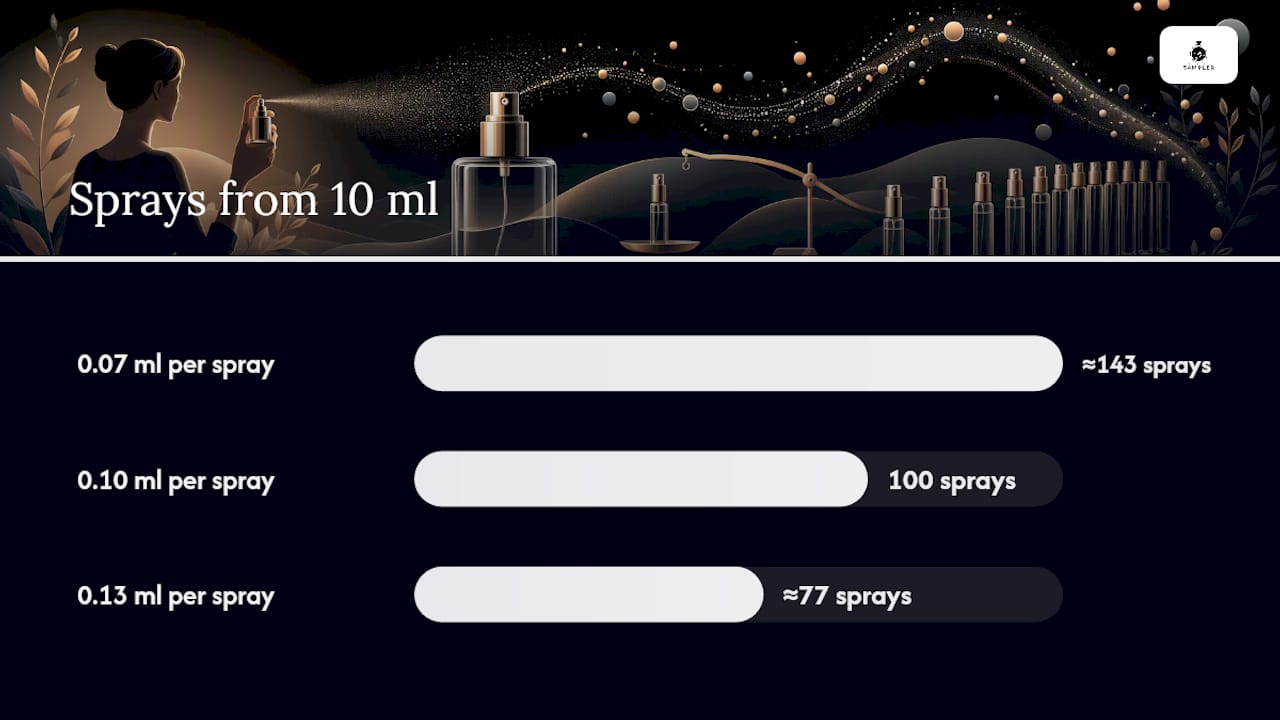
Here’s the working: 10ml ÷ 0.10ml per spray = 100 sprays. Switch to a finer atomiser dispensing 0.07ml per spray, and the same bottle stretches to around 143 sprays. A heavier pump at 0.13ml per spray brings you down closer to 77 sprays. That’s a wide spread from a single 10ml bottle, and it’s exactly why fragrance shoppers get different answers depending on which chart they check.
Spray-count table for 10ml at common atomiser outputs
The perfume ml to oz converter tool breaks this down cleanly using three common atomiser outputs. Here’s what 10ml delivers at each:
| ml per spray | Sprays in 10ml | Descriptor |
|---|---|---|
| 0.07ml | 143 sprays | Fine mist |
| 0.10ml | 100 sprays | Typical spray |
| 0.13ml | 77 sprays | Heavy spray |
Most standard atomisers sit somewhere between the fine and typical rows, which lines up with the 100 to 150 spray range you’ll see on most bottle-size charts. If you’re unsure which row applies to your bottle, assume the heavier end. It’s the safer number to plan around.
How long does a 10ml decant actually last?
Spray counts only matter once you convert them into calendar time. Using a mid-range output of 0.10ml per spray (100 sprays total from 10ml), here’s what different daily habits look like:
- One spray a day (a light, personal scent worn close to the skin): roughly 100 days, or over three months.
- Two sprays a day (a typical single application to wrist or neck): around 50 days, close to seven weeks.
- Three sprays a day (chest, wrist, and clothing for stronger projection): about 33 days, roughly a month.
- Four sprays a day (heavy application or hot climates where scent fades faster): around 25 days, or three and a half weeks.
Real-world estimates back this up. One usage breakdown puts a 10ml bottle at 100 to 120 sprays, translating to roughly three to six weeks for many people. For travel, a 10ml decant is a strong match for a three-week holiday if you’re applying two to three sprays daily, with a little left over. If you’re unsure how heavy your hand is, plan for the shorter end of the range rather than the longer one.
What changes your spray count and what to watch for
The numbers above assume a well-functioning, standard atomiser. Real bottles rarely behave that consistently, and several variables push your actual count up or down.
- Atomiser and nozzle design: worn or partially clogged nozzles release less liquid per press, quietly reducing your effective spray count over time.
- User technique: a quick, light press delivers less than a firm, sustained one, and spraying from further away wastes product into the air rather than onto skin or fabric.
- Product formulation: thicker, oil-heavier formulas can flow differently through the same pump compared with lighter eau de toilette concentrations.
- Temperature: cold bottles thicken liquid slightly, which can reduce output until the product warms to room temperature.
- Bottle type: refillable travel atomisers often have looser tolerances than original manufacturer sprayers, so a decant poured into a travel atomiser may not match the brand’s factory-fitted pump exactly.
Pro Tip: If you’ve decanted into a refillable travel atomiser, test its output separately from the original bottle. The two pumps rarely dispense identical volumes, even from the same fragrance.
How do you measure your own sprayer’s real output?
Guessing is unnecessary when the test takes two minutes. All you need is a small kitchen scale (or a syringe) and an empty vial to catch the spray.
- Weigh your fragrance bottle (or an empty vial, if you’re testing an atomiser) before spraying.
- Spray 10 times into the air or into the vial, well away from your face and any fabric.
- Weigh the bottle again and calculate the difference in grams, which is roughly equivalent to millilitres for most fragrance concentrations.
- Divide that figure by 10 to get your ml-per-spray output.
Say your 10 test sprays used 1ml of product. That’s 0.10ml per spray, which means your specific atomiser will give you approximately 100 sprays from a 10ml bottle. Run the test once and you’ll have a personal figure more reliable than any general chart.
Publisher verification: decants and atomisers in practice
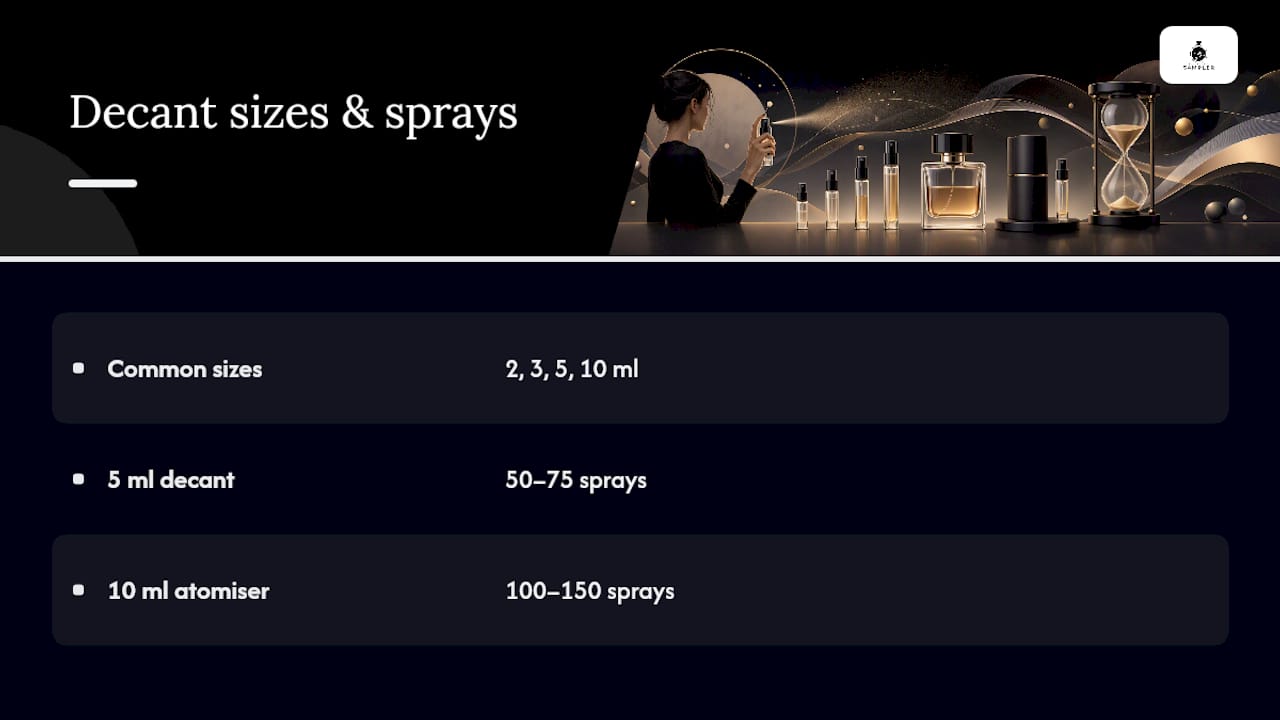
Fragrance decants are sold in 2ml, 3ml, 5ml and 10ml sizes, alongside original 10ml atomisers, so the spray-count maths above maps directly onto real products rather than theoretical bottle sizes. A 5ml decant, following the same logic, typically yields somewhere between 50 and 75 sprays depending on atomiser output, half the range of its 10ml equivalent.
For readers weighing up sizes before buying, the sample size benefits guide compares spray counts across common decant sizes. Anyone decanting their own fragrance into a travel atomiser should also read the practical decanting guide first, since pouring technique affects how consistently the new sprayer performs.
When is a 10ml decant the right buy?
A 10ml decant earns its place when you’re testing a new scent, packing for travel, or putting together a small gift. It gives enough sprays to properly judge how a fragrance develops on your skin across several wears. If you already know a fragrance is a long-term favourite, a full bottle works out cheaper per spray.
— Rupesh
Where to buy 10ml decants and atomisers
Once you know your rough spray count, buying the right size becomes far easier. 10ml decants and original atomisers are stocked directly, so you can match a size to your daily spray habit rather than committing to a full bottle before you’re sure a scent suits you.
If you’re new to decanting, the why decants page explains the cost and flexibility case for buying samples over full bottles in plain terms. For a working example of what a 10ml listing looks like in practice, the BOSS Bottled Absolu Parfum Intense decant page shows sizing options side by side. Pick your usual daily spray count, check it against the table above, and choose the decant size that matches how long you actually want the bottle to last.
Sources
- Perfume bottle sizes guide
- Perfume ml to oz converter: How many sprays per bottle
- Professional guide to perfume bottle standards
- How long does 10ml cologne last? Sprays, weeks, and real-use math