
College fragrance testing guide: sample smart on a student budget
Test on a blotter first to cut your list to a small number of scents, then take decants of the finalists home for a proper skin trial across two days, checking in at various timed intervals. This works because your skin’s chemistry, not the bottle, decides what a fragrance actually becomes. A staged, timed wear test using blotter plus skin is the most reliable way to judge whether a scent holds up or just smells good for ten minutes in a shop.
Three things make this method work rather than just sound sensible:
- Skin chemistry changes the fragrance. pH, temperature, and even your skincare routine affect how notes develop, which a paper strip can never replicate.
- Fragrances move through stages. IFRA’s industry guidance on fragrance composition explains why the opening spray rarely resembles what you smell four hours later.
- A repeatable protocol removes guesswork. Scoring the same checkpoints each time turns a vague impression into a decision you can actually trust.
For students, the practical fix is simple: skip full bottles until you’ve lived with a scent for a couple of days. Small decants or 5ml testers from a source like Theperfumesampler let you run this exact protocol without spending £100 on something you might return.
Pro Tip: Carry two blotters per fragrance, not one. Label one immediately after spraying and sniff the second an hour later. Comparing the two side by side shows you exactly how much a scent has shifted.
Key Takeaways
The most reliable way to choose a fragrance is a repeatable, timed skin test using decants across two days, checked at 15 minutes, one hour, and four hours.
| Point | Details |
|---|---|
| Shortlist on blotters first | Use in-store blotter testing to narrow dozens of options down to three or four worth trying further. |
| Test on skin, not just paper | Skin chemistry changes a fragrance completely, so a blotter alone can never confirm longevity or comfort. |
| Follow the three checkpoints | Check impressions at 0–15 minutes, 30–60 minutes, and 2–4 hours before deciding anything. |
| Repeat across two days | One good test can be a fluke; two different days and settings confirm whether a scent truly works. |
| Build a small rotation | Two or three scents, one daily, one light, one evening, covers most student situations without overspending. |
| Sample before you commit | Decants from Theperfumesampler let you run the full testing protocol in 2ml to 10ml sizes at a fraction of full-bottle cost. |
Table of Contents
- How do you prepare for a college fragrance testing session?
- Should you test fragrances in-store or at home?
- What is the best step-by-step process for testing fragrances?
- How do you judge a fragrance’s drydown, sillage, and longevity?
- How many fragrances should you keep in rotation?
- What are the most affordable ways to test fragrances?
- What testing mistakes cost students the most money?
- Why does a sample-first strategy actually reduce buyer’s remorse?
- Where can students find fragrance samples near campus?
- What are the main fragrance families to know before buying?
- A quick note from the writer on testing fragrances as a student
- Ready to test fragrances properly? Start with a decant
- Sources
How do you prepare for a college fragrance testing session?
Bad results usually come from bad conditions, not bad fragrances. Before you even walk into a shop or open a decant, get your testing environment neutral.
Skip scented body wash, moisturiser, or laundry detergent on testing day. A vanilla-scented shower gel will fight with every fragrance you try afterwards and make the top notes impossible to judge fairly. The best window for testing is mid-morning, an hour or two after showering, once your natural skin oils have settled but before the day’s smells (coffee, lunch, someone’s Lynch Africa deodorant in the lecture hall) start interfering.
If you’re testing multiple fragrances in one sitting, step outside for two or three minutes between each one. Fresh air resets your nose faster than sniffing coffee beans, and it costs nothing.
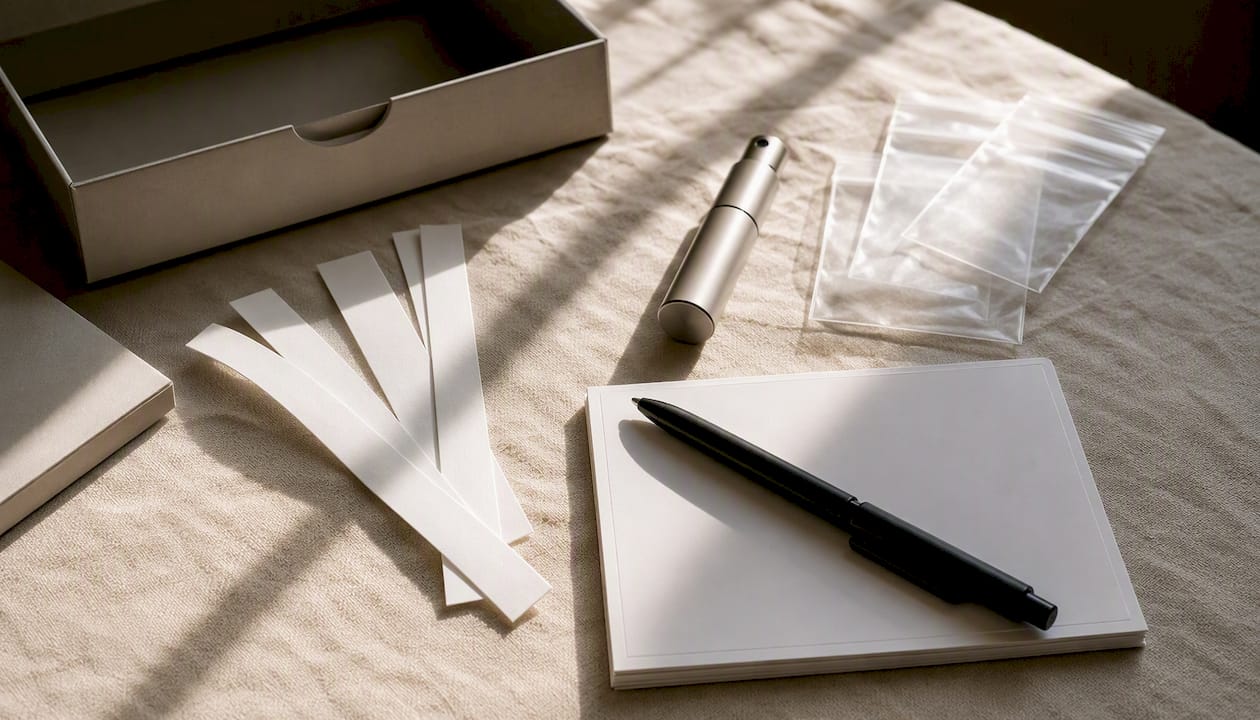
A minimalist testing kit fits in any backpack: a handful of blank blotter strips, a small unlabelled atomiser if you’re decanting from a larger sample, a pen, a simple score sheet (even a notes app works), and a few small sample bags to keep decants from leaking onto your textbooks.
Pro Tip: If you wear a fragrance daily, don’t test new scents on the same day. The residual trail on your skin and clothes will muddy every new impression, even after a shower.
Should you test fragrances in-store or at home?
Both, in that order. Each does a different job, and relying on just one leads to bad purchases.
In-store blotter testing is fast and free. Spray, sniff, move on. It’s brilliant for eliminating fragrances that smell aggressive, synthetic, or simply wrong within the first thirty seconds, and for narrowing forty options down to four or five worth taking further. What it cannot do is tell you anything about longevity, sillage, or how the fragrance interacts with your actual skin, because paper blotters miss skin chemistry entirely. A scent that smells stunning on card can turn sharp or soapy within an hour on your wrist.
At-home skin testing with a decant is where the real decision gets made. This is where you find out if a fragrance actually survives your body heat, your daily routine, and a full lecture block. It takes longer, but it’s the only way to see true drydown and how long a scent realistically lasts on you.
The workflow that works best for most students: shortlist three or four candidates on blotters during a single shop visit, then order or buy small decants of your top two or three and live with each one for two to three days before committing to anything larger.
Pro Tip: Test at-home candidates on different days of the week. A fragrance that feels great during a quiet Tuesday in the library might feel completely wrong at a Friday night event, and you want to know that before you buy a full bottle.
What is the best step-by-step process for testing fragrances?
Stick to a maximum of a few fragrances per session to avoid nose fatigue. Beyond that, your nose fatigues and everything starts to smell the same. Research into olfactory perception and adaptation supports this limit directly. This is not a preference, it’s how your nose physically works after repeated exposure.
- Check the blotter first. Spray once from roughly the same distance each time and let it sit for thirty seconds before your first sniff. This eliminates the harshest alcohol-forward openers immediately.
- Move to skin. If the blotter passes, apply one spray to your inner wrist or inner elbow. Don’t rub it in. Rubbing breaks down the fragile top-note molecules through friction and heat, so let it settle naturally.
- Record the 0 to 15 minute opening. This is the top note, often citrus, aldehydes, or light florals. Write down your gut reaction, good or bad.
- Check back at 30 to 60 minutes. This is the heart of the fragrance and your main decision point, since it’s closest to what you’ll smell most of the day.
- Do a final check at 2 to 4 hours. This reveals the base notes and tells you the truth about longevity, whether the scent has faded to nothing or turned into something you didn’t sign up for.
- Reset with water and fresh air between fragrances, never coffee beans, which desensitise your nose more than they cleanse it.
- Repeat the whole process on a second day, ideally in a different setting such as walking across campus or sitting through a lecture, before making a final call.
Two testing days, same protocol, is usually enough to know whether a fragrance is genuinely for you or just a novelty that impressed you once.
How do you judge a fragrance’s drydown, sillage, and longevity?
The 30 to 60 minute mark tells you who a fragrance actually is. This is what industry primers on fragrance stages call the heart, and it’s the most representative phase of the whole experience, more honest than the opening spray and more developed than the first ten minutes on a blotter.
Sillage, how far a scent travels from your skin, matters more for students than almost any other group. You’re in tight lecture halls, shared dorm rooms, and crowded libraries. A fragrance with huge projection that feels glamorous at a party can become genuinely uncomfortable for the people sitting next to you in a 9am seminar. Pay attention to whether people three feet away notice it, or whether you have to lean in to smell it on yourself by hour two.
Comfort matters as much as impressiveness. A fragrance you love in isolation but that gives you a headache by hour three isn’t a fragrance you’ll actually wear. Watch for that specifically, because it’s a more common problem than people expect, especially with heavily synthetic musks and amber accords.
| Checkpoint | What to note | Projection | Longevity signal |
|---|---|---|---|
| 0–15 min | First impression, top notes | Strong, close to skin | Too early to judge |
| 30–60 min | Heart notes, true character | Should settle to arm’s length | Good sign if still present |
| 2–4 hrs | Base notes, comfort check | Should be close to skin only | Reveals real staying power |
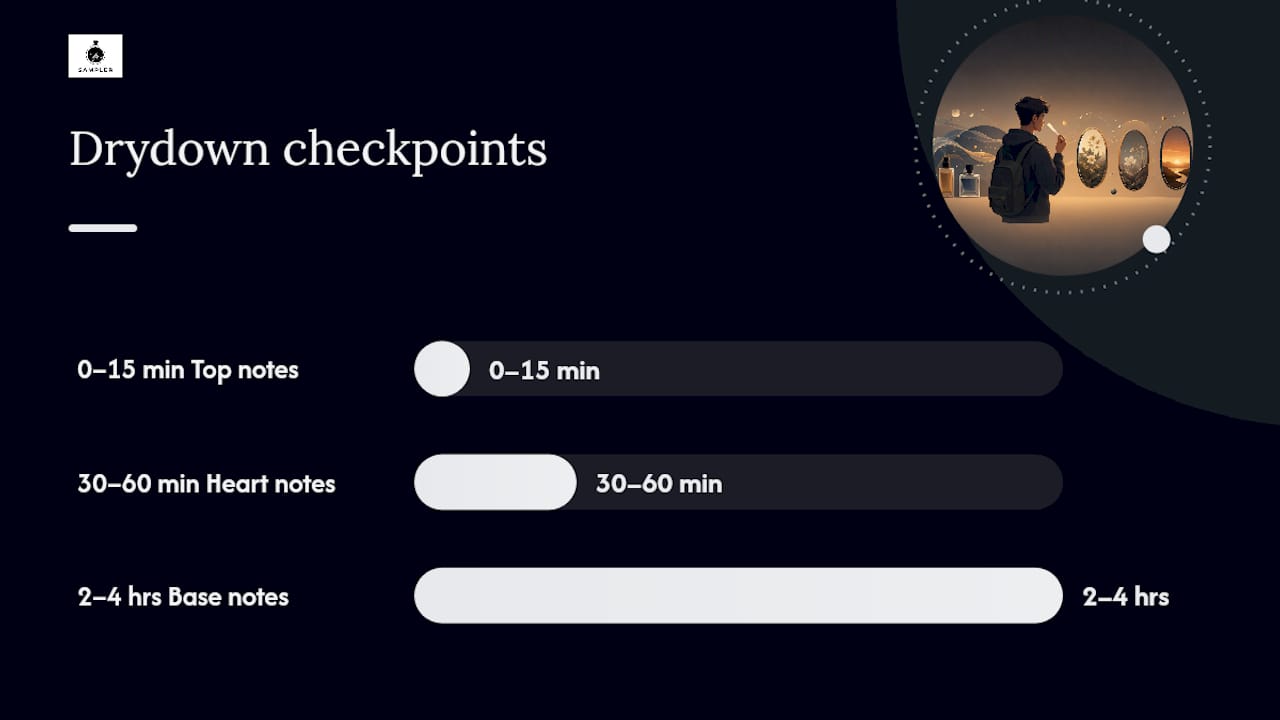
If a fragrance passes all three checkpoints without becoming cloying or fading to nothing, it’s worth a second day of testing before you buy.
How many fragrances should you keep in rotation?
Two or three scents cover almost every situation a student needs, and building beyond that is usually where money gets wasted. This mirrors what fragrance selection guides consistently recommend: treat scent choice as building a small, functional wardrobe rather than hunting for one perfect signature.
A workable rotation looks like this: one reliable Eau de Parfum for daily classes and general use, one lighter, fresher option for hot days or the gym, and one warmer, cosier scent kept for evenings and social events. That’s it. You don’t need six bottles gathering dust on a shelf in a shared room.
Layering stretches every one of those scents further. Using an unscented or lightly scented body lotion as a base before spraying can meaningfully extend how long a fragrance lasts on your skin, since moisturised skin holds fragrance better than dry skin. Just avoid pairing scents from clashing families, a heavy oud fragrance layered under a delicate citrus rarely goes well.
Concentration also determines how a scent fits your rotation. Body mists last an hour or two at most. Eau de Toilette (EDT) typically runs four to six hours. Eau de Parfum (EDP) often lasts six to eight hours or more. Parfum and fragrance oils can last a full day on the right skin. Knowing this before you buy tells you whether you need a heavier concentration for a long day of classes or something lighter for a quick trip to the gym.
- Daily/academic: one EDP you trust completely, tested and confirmed over multiple days.
- Hot weather or workouts: a lighter EDT or citrus-forward scent that won’t turn cloying with sweat.
- Evenings and socials: something warmer with amber, vanilla, or spice, worn less often so it stays special.
Pro Tip: If two fragrances in your rotation share the same dominant note (vanilla, for instance), you’ll struggle to tell them apart after a few weeks. Pick contrasting families instead.
What are the most affordable ways to test fragrances?
Decants are the most efficient sampling route available to students, and the reasoning is straightforward: low cost per test, multiple full wears from a single small vessel, and almost no wasted product compared with buying a full bottle to find out you dislike it. Sites like Theperfumesampler exist specifically to solve this problem, offering niche and designer fragrances in 2ml, 3ml, 5ml, and 10ml sizes.
Small decants typically support multiple wear tests depending on usage, while larger decants can stretch to many more. Compare that to a full 100ml bottle costing anywhere from £60 to £180, and the maths on testing before committing becomes obvious. Retail discovery sets and travel-sized testers work on the same logic, though they typically offer less variety than a dedicated decant seller.
Other budget routes worth knowing: many boutiques will hand out a small carded sample if you ask politely and explain you’re deciding between a few options, brand websites occasionally run sample programmes tied to purchases, and some students organise informal swaps within dorms or friend groups to try scents they’d never buy blind. None of these match the consistency of a proper decant, but they’re worth using alongside one, particularly early in your search when you’re still working out which fragrance families you actually like.
Pro Tip: When asking staff for a sample, be specific: “Could I get a small sample of this to test at home over a couple of days?” tends to get a better response than a vague request, since it signals you’re a serious, considered buyer rather than someone collecting freebies.
What testing mistakes cost students the most money?
The single most expensive mistake is buying a full bottle immediately after one good sniff in a shop. First impressions, formed in thirty seconds under fluorescent lighting, are notoriously unreliable predictors of how you’ll feel about a scent after wearing it all day.
Other errors show up constantly:
- Testing more than five fragrances in one session, which guarantees nose fatigue and unreliable judgements by the third or fourth spray.
- Rubbing your wrists together after applying, which heats and breaks down the top notes before you’ve even smelled them properly.
- Relying only on blotter tests and skipping skin trials entirely, missing everything a fragrance does after the first hour.
- Buying based on how a fragrance smelled on a friend, without accounting for how differently it will read on your own skin.
Watch for genuine red flags during testing, too. A fragrance that turns suddenly sharp or chemical-smelling in its base stage, one that gives you a headache after several hours of wear, or projection so heavy it fills a small room, these are all signs to walk away, regardless of how good the opening spray was.
If a friend says a fragrance smelled completely different on them, that’s not a fault in the fragrance, it’s simply skin chemistry doing what it does. It’s the exact reason a testing protocol built around your own skin, not someone else’s recommendation, matters so much.
Why does a sample-first strategy actually reduce buyer’s remorse?
The science backs up what careful buyers already suspect. Fragrances move through top, heart, and base stages over several hours, and staged drydown timing explains why a scent that seems perfect in the first ten minutes can feel completely different by the afternoon. Testing only the opening spray gives you a fraction of the full picture.
Skin chemistry compounds this further. Two people applying the identical spray from the identical bottle will experience measurably different results, because pH, body temperature, and skin oils all interact with fragrance molecules differently. That’s not a flaw in the fragrance, it’s simply how skin works, and it’s precisely why a blotter test alone will never be sufficient.
Consider a simple two-day decant test: on day one, a fragrance smells striking within the first hour but has faded to almost nothing by hour three, a common pattern with fragrances that lean heavily on volatile top notes. On day two, testing a second candidate, the opening is quieter but the fragrance is still clearly present at hour four, developing into a warmer, more grounded character. The second fragrance, despite the less exciting first impression, is the one that actually holds up as a daily option. Without the two-day skin test, you’d have bought the first one and been disappointed within a week.
| Sample size | Approximate wear tests | Typical cost-per-wear |
|---|---|---|
| 2ml decant | multiple wear tests | lowest cost per test |
| 5ml decant | many wear tests | slightly higher upfront, still economical |
This cost-per-wear logic is exactly why decants and micro-doses suit student budgets far better than full bottles bought on a hunch.
Where can students find fragrance samples near campus?
Department stores and dedicated fragrance boutiques remain the most reliable starting point, since staff can pull almost any bottle in stock for an immediate blotter test. Most will also hand over a small sample vial if you explain you’re comparing a few options before buying, particularly at quieter times of day when staff have more time to help.
Beyond physical shops, dedicated campus fragrance guides cover which local retailers and online sources tend to work best for students balancing tight budgets with limited storage space in shared accommodation. Online decant sellers solve the access problem entirely for anyone without a mall or department store nearby, letting you order specific niche or designer fragrances in small sizes without travelling anywhere. This matters particularly for students on campuses in smaller towns where fragrance counters are limited to two or three mainstream brands.
Dorm swaps and friend networks are worth mentioning again here specifically for access, not just cost. If someone in your building already owns a fragrance you’re curious about, asking to try a small amount is a normal, low-pressure way to explore before spending anything at all.
What are the main fragrance families to know before buying?
Understanding fragrance families turns testing from guesswork into pattern recognition. Once you know which family you gravitate towards, shortlisting new candidates gets dramatically faster.
Fresh fragrances lean on citrus, aquatic, and green notes, think bergamot, grapefruit, and cut grass. They’re light, versatile, and tend to suit warm weather and daytime wear.
Floral fragrances build around notes like rose, jasmine, and iris, ranging from delicate and powdery to rich and heady depending on concentration.
Oriental (sometimes labelled amber) fragrances use warm, spiced notes such as vanilla, cinnamon, and amber resin, generally suiting cooler weather and evening wear.
Woody fragrances centre on sandalwood, cedar, and vetiver, offering a grounded, often unisex character that works well across seasons.
Gourmand fragrances lean into edible-smelling notes like caramel, chocolate, or coffee, popular currently but capable of feeling heavy in warm conditions or crowded rooms.
Most fragrances blend two or three families rather than sitting purely in one, which is exactly why a practical workflow for analysing notes helps once you’re comparing candidates that all claim to be “woody florals” but smell nothing alike.
A quick note from the writer on testing fragrances as a student
Most fragrance advice online assumes you’ve got money to burn and no timetable to work around. Neither is true for most students, which is why the testing method laid out here leans so heavily on decants and repeat checks rather than one dramatic shop visit.
One thing worth saying plainly: the fragrance that wins over a two-day test is rarely the one that made the biggest impression in the shop. A scent tested during a long lecture, then again on a walk across campus in different weather, tells you far more than thirty seconds under shop lighting ever could. Some of the most durable choices are the quieter ones, the fragrances that don’t announce themselves in the first ten minutes but are still there, comfortably, four hours later.
Keep a simple score sheet and actually use it. Memory is unreliable after testing three or four scents in a week, and a written record of how each one behaved at 15 minutes, an hour, and four hours saves you from re-testing the same candidates twice.
Ready to test fragrances properly? Start with a decant
Everything covered above points to the same conclusion: you cannot judge a fragrance properly from a single shop spray, and buying a full bottle before testing is how most fragrance regret happens. Theperfumesampler solves this directly by offering niche and designer fragrances as decants in 2ml, 3ml, 5ml, and 10ml sizes, so you can run the full two-day skin test on several candidates for a fraction of what a single full bottle would cost.
Start with two or three decants of fragrances you shortlisted on blotters, ideally one from each family you’re curious about, so you’re comparing genuinely different scents rather than three near-identical woody florals from the Fragrance category. A 2ml size is enough for eight to twelve full wear tests, plenty to run the complete checkpoint protocol across two separate days. Once you’ve found the one that survives the four-hour mark and still gets compliments, decants make it easy to confirm you’ve picked the right scent before spending on a full bottle. Browse the current selection and put together your first testing set today.
Sources
- How to Test a New Perfume Like a Pro (PerfumerOnline)
- IFRA - International Fragrance Association
- Pmc
- How to Properly Test Perfume: Tips from a Stylist — MioLook