
How to match perfume to outfits: quick style pairings
TL;DR:
- Matching fragrance to outfits depends on temperature, fabric weight, and occasion for harmony.
- Testing scents on skin before wearing helps determine how they will complement your clothing choices.
Three rules cover most outfit-to-scent decisions. Match the temperature of your fragrance to the mood of your outfit: warm amber and vanilla notes suit warm, rich colours and heavy fabrics, while cool citrus and aldehydes sit better with crisp, pale, or structured looks. Match scent density to fabric weight: light sprays for silk and chiffon, fuller woody or resinous bases for tweed and cashmere. Match intensity to occasion: subtle sillage for the office, a fuller presence for evening.
Treat perfume as an invisible accessory. Aligning the emotional weight of a colour with the fragrance’s energy creates a cohesive personal statement rather than two competing signals.
Those three rules are enough to get started. The sections below explain why each works, give ready-made pairings by style archetype, and show how to test options without committing to a full bottle.
Pro Tip: Before applying any new scent with an outfit, spray it on your inner wrist the evening before and check the dry-down after two hours. The base notes you smell then are what your outfit will carry all day.
Table of Contents
- How to match perfume to outfits by style archetype
- How does fabric affect which scent you should wear?
- What intensity and sillage suit different occasions?
- How do you test and layer scents safely?
- Ten instant outfit-to-scent pairings you can use now
- Key takeaways
- Why thinking like a stylist produces better scent choices
- Try before you commit: sample packs and decants for outfit pairing
How to match perfume to outfits by style archetype
Every style archetype carries its own energy, and the right fragrance family reinforces that energy rather than contradicting it. Colour temperature and saturation affect acceptable sillage: pastels call for low-density, watercolour-like scents, while deeply saturated or neon tones can carry denser, longer-lasting compositions.
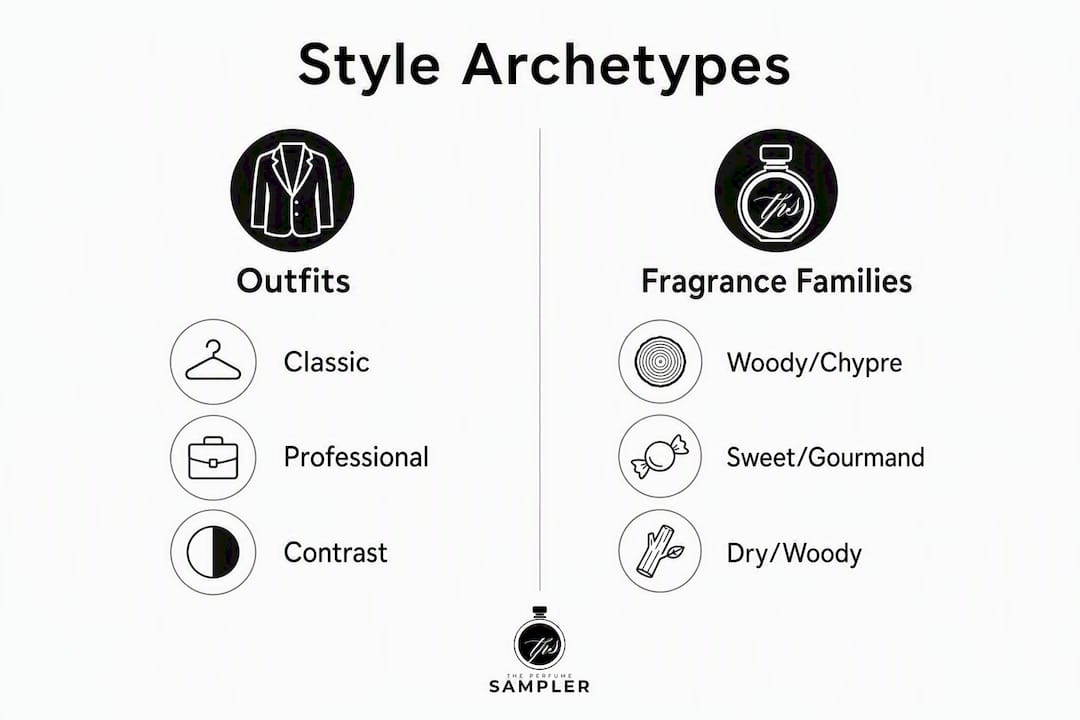
| Style archetype | Typical outfit example | Fragrance family | Suggested notes |
|---|---|---|---|
| Classic / minimalist | White shirt, tailored trousers | Aldehydic, clean musk | Iris, white musk, cedar |
| Bold / trend-led | Saturated colour-block co-ords | Oriental, gourmand | Amber, oud, dark vanilla |
| Romantic / feminine | Floral midi dress, soft layers | Floral, powdery | Rose, peony, soft musk |
| Edgy / androgynous | Leather jacket, wide-leg trousers | Woody, leather | Vetiver, patchouli, smoke |
| Bohemian / arty | Linen layers, earthy tones | Earthy, resinous | Sandalwood, incense, amber |
| Sporty / athleisure | Joggers, technical fabric | Citrus, aquatic | Grapefruit, sea salt, green |
| Professional / formal | Tailored suit, structured dress | Chypre, dry woody | Oakmoss, bergamot, cedar |
For professional and business attire, dry woody, chypre or green compositions are the recommended choice. Sweet gourmand notes can feel out of place in formal settings.
Contrast is a legitimate styling tool. Pairing a soft floral dress with a dry, woody scent creates a contemporary edge that feels considered rather than accidental. Fragrance used this way works like an unexpected accessory: a rugged leather jacket with a delicate floral, or a sharp tailored suit with a warm, resinous oriental. The contrast signals intention. Your fragrance aesthetic does not have to mirror your outfit literally; sometimes the most memorable combinations are the ones that push back slightly.
How does fabric affect which scent you should wear?
Fabric density changes how a fragrance evaporates and how far it projects. Dense, textured fabrics like tweed and cashmere trap scent molecules and release them slowly, which amplifies base notes and extends sillage. Lightweight fabrics like silk and chiffon allow faster evaporation, so top notes disappear quickly and the overall impression stays lighter.
Crisp, structured fabrics pair best with clean, structured fragrances: citrus and aldehydic notes match the precision of poplin or starched cotton. Heavy, tactile fabrics need a grounded olfactory base: woody notes, resins, and tobacco sit naturally on tweed or cashmere. Flowing silk favours lighter accords.
Practical fabric-to-scent mappings:
- Crisp cotton / poplin: aldehydes, citrus, green notes. The fabric’s clean structure mirrors the sharpness of these families.
- Silk / chiffon: airy florals, aquatic accords. Fast evaporation suits top-note-led compositions that feel light on skin.
- Tweed / cashmere / velvet: woody, resinous, leather. Dense fibres hold base notes well and reward richer, slower-burning compositions.
- Linen: light citrus, herbal, ozonic. Linen’s casual, breathable quality suits uncomplicated, fresh scents.
- Technical / performance fabric: citrus, aquatic, clean musk. Matches the utilitarian, energised mood of activewear.
Modern evening styling often favours clear, skin-friendly molecular notes such as ambroxan-based accords to add polish to velvet or silk without overwhelming the look. The old assumption that luxe fabrics require heavy orientals no longer holds.
Pro Tip: Never spray directly onto delicate silk or chiffon. Apply to pulse points on skin instead, and let the fabric pick up the scent naturally. Direct application can leave oil marks that are difficult to remove.
What intensity and sillage suit different occasions?
Context defines how much fragrance is appropriate. The same scent applied at different concentrations reads entirely differently: two sprays on a pulse point for a morning meeting, four or five for an evening event. A single versatile scent can be adapted across outfits by varying application rather than switching bottles.
Determine the desired atmosphere of the event first. The fragrance should support that atmosphere and the outfit, not compete with either.
Occasion-by-occasion guidance:
Daywear and office: two to three sprays on wrists and neck. Prefer dry woods, chypre, green, or light florals. Avoid heavy gourmands and dense orientals, which can feel intrusive in shared spaces.
Casual / weekend: three sprays, pulse points. Citrus, aquatic, and clean musk families match the simplicity of casual attire without weighing down a relaxed look.
Evening / formal: four to five sprays, including hair and clothing hem. Orientals, woody florals, and ambroxan-based compositions project well and suit the lower light and closer proximity of evening settings.
Seasonal adjustment: nautical events and summer outfits suit sea-salt and ozonic accords; winter formalwear favours warming spices and woods. Spring and summer call for lighter concentrations, even from the same bottle, because heat amplifies projection. Autumn and winter reward heavier bases that need cool air to slow their release.
The psychological link between clothing and mood applies equally to scent: the right fragrance for an occasion reinforces confidence in the same way a well-chosen outfit does.
How do you test and layer scents safely?
Testing a fragrance properly takes time, and the process matters. A scent on a blotter in a shop tells you almost nothing about how it will perform on your skin with your outfit.
A reliable testing sequence:
- Blotter test: get a first impression of the top notes and overall character.
- Skin patch: apply to inner wrist, wait 20 minutes, and assess the heart notes as the alcohol burns off.
- Sleeve hem test: apply a small amount to the inside of a sleeve hem on the fabric you plan to wear. Check after two hours for the dry-down.
- Full day wear: wear the scent with the actual outfit for a full day. Note how the base notes develop and whether the sillage feels appropriate for the occasion.
Decants and sample sizes make this process practical. Rather than buying a full bottle to test a pairing, a 2ml or 5ml decant gives you enough for several wears across different outfits and settings. Building a small capsule of three to five decants covering different fragrance families lets you test pairings systematically over a week without significant cost.
Layering pairs complementary families: vanilla with delicate florals, citrus with woods. Apply the lighter scent first, let it settle for a minute, then add the denser one on top. Keep quantities small on both; muddiness comes from applying too much of either. When in doubt, a single well-chosen scent outperforms a clumsy layer.
Pro Tip: Keep a small travel kit of three decants in your bag: one fresh/citrus for daywear, one floral or woody for afternoon, one richer oriental for evening. Swap based on where the day takes you rather than committing to one scent at 7am.
Ten instant outfit-to-scent pairings you can use now
- White linen dress → light citrus / ozonic → bergamot, sea salt, white musk
- Navy blazer and tailored trousers → chypre / green → oakmoss, bergamot, vetiver
- Black evening dress → woody floral / ambroxan → rose, sandalwood, ambroxan
- Grey tracksuit / athleisure → clean aquatic / citrus → grapefruit, aquatic accord, clean musk
- Tweed coat → resinous woody → tobacco, cedar, labdanum
- Pastel sundress → soft floral / powdery → peony, iris, light musk
- Leather jacket and dark jeans → smoky leather / patchouli → vetiver, smoke, dark amber
- Cashmere jumper → warm oriental → vanilla, benzoin, sandalwood
- Tailored suit (work) → dry woody / aromatic → cedar, dry herbs, light bergamot
- Floral midi dress → contrast woody → dry vetiver, white cedar, a touch of pepper
Key takeaways
Matching fragrance to an outfit works best when you align scent temperature with colour mood, density with fabric weight, and intensity with occasion.
| Point | Details |
|---|---|
| Warm vs cool temperature | Match warm amber and vanilla notes to rich, warm colours; use citrus and aldehydes with crisp, cool palettes. |
| Fabric density rule | Heavy fabrics like tweed and cashmere hold base notes well; lightweight silk and chiffon suit airy, top-note-led compositions. |
| Occasion intensity | Two to three sprays for daywear and office; four to five for evening. Adjust application, not necessarily the scent. |
| Contrast as a tool | Deliberately pairing a soft outfit with a dry woody scent creates a modern, considered signature. |
| Sample before committing | Theperfumesampler offers decants in 2ml, 3ml, 5ml, and 10ml sizes, making it practical to test pairings before buying a full bottle. |
Why thinking like a stylist produces better scent choices
The most common mistake in pairing fragrance with outfits is approaching it note-by-note rather than mood-by-mood. Matching a rose note to a floral dress, or a woody note to a brown coat, is mechanical. It produces technically correct results that feel flat.
Stylists do not dress a body; they dress a moment. The question is never “what colour is this fabric?” but “what does this look need to say?” Fragrance works the same way. A sharp, dry chypre on a soft romantic dress creates tension that reads as confidence. A warm oriental on a minimalist white shirt adds depth that the outfit alone cannot carry. The science behind scent and identity supports this: fragrance shapes how others perceive you before a word is spoken.
Sampling is where this thinking becomes practical. Testing a pairing over a full day, on the actual fabric, in the real environment, tells you far more than any rule. A small collection of decants covering three or four fragrance families gives you enough range to dress intentionally for most occasions. That is a more useful wardrobe than a single expensive bottle worn regardless of context.
Try before you commit: sample packs and decants for outfit pairing
Buying a full bottle to test a pairing is an expensive way to find out it does not work. Theperfumesampler offers a practical alternative: fragrance decants in 2ml, 3ml, 5ml, and 10ml sizes, drawn from authentic niche and designer fragrances.
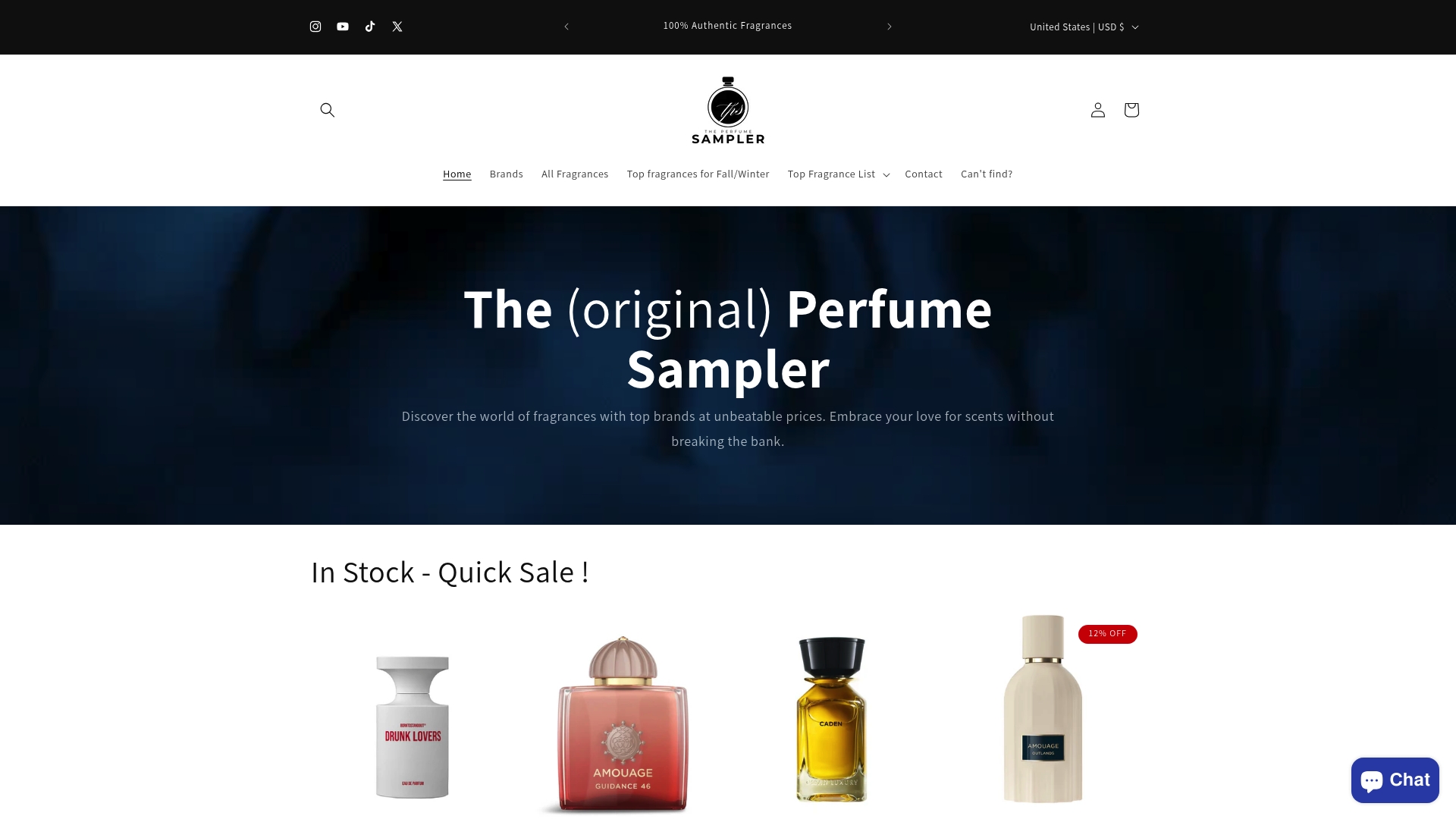
A straightforward approach: choose three to five decants across different fragrance families, wear each one with a specific outfit type over the course of a week, and note which pairings feel right at dry-down. By the end of the week, you have real-wear data rather than a guess. For readers ready to go further, full bottles of luxury fragrances are also available, including options such as BOSS Bottled Absolu Parfum Intense, a warm, resinous woody that pairs well with tailored autumn and winter outfits.
Visit Theperfumesampler to browse sample sizes and build a small testing wardrobe without the full-bottle commitment.
Sources and further reading
- How to Match Perfume to Your Clothing Style — MioLook: detailed fabric-to-scent mapping and modern evening styling guidance.
- Colour olfactory: how to match perfume to your clothes — MioLook: colour temperature and saturation as a guide to sillage and scent density.
- Perfumes that pair well with your favourite outfit colours — Perfumegini: colour-driven fragrance choices and the invisible accessory concept.
- How to match perfume with your outfit — Perfumegini: spray-count guidance and minimalist fragrance wardrobe strategy.
- How to pair fragrances with your outfits — Gentleman’s Gazette: occasion and atmosphere-first approach to scent selection.
- How to match your perfume to your outfit — Resident: casual and active attire pairing advice.
- How to layer perfume and fragrances — Ulta Beauty: practical layering combinations and proportions.
- Theperfumesampler: decants and sample sizes for testing pairings across outfit types.
Recommended
- Popular aesthetic fragrance choices: find your signature scent – ThePerfumeSampler
- How perfume empowers self-expression and personal style – ThePerfumeSampler
- How to choose romantic fragrances: a practical guide – ThePerfumeSampler
- Guide to profiling fragrance personalities: find your scent – ThePerfumeSampler