

How to balance fresh and sweet scents without one overpowering the other
Anchor your fragrance with the sweeter, heavier scent first, then lift it with a fresh top layer. Start with a ratio favouring more fresh scent than heavy scent, and adjust from there once you know how your skin carries it. This works because sweet notes like vanilla and amber project harder and last longer than citrus or aquatic notes, so giving the fresh layer the numerical advantage stops the whole thing turning cloying by mid-afternoon.
Try this now:
- Apply a few sprays of the sweeter scent to your pulse points and let it settle for a minute.
- Follow with several sprays of the fresher fragrance over the top and on clothing.
- Wait an hour before judging the blend. Layers need time to integrate.
Starting ratio: 1 part sweet base : 3 parts fresh top. Adjust up or down once you’ve tested it once on skin.
Key Takeaways
Balancing fresh and sweet scents comes down to a controlled ratio, a clear hierarchy between lead and support, and testing on skin before committing to a full bottle.
| Point | Details |
|---|---|
| Starting ratio | Apply roughly 1 part heavier sweet scent to 3 parts fresh scent, then adjust. |
| Application order | Moisturise, apply the sweet base to pulse points, wait, then layer the fresh top more broadly. |
| Choose simple supports | Pair a complex lead with a simpler support fragrance to avoid muddiness. |
| Adjust for heat | Reduce sweet-note sprays in warm or humid weather since heat boosts projection. |
| Fix overpowering sweetness | Dilute with unscented lotion or add a citrus micro-spray as a counterweight. |
| Test before committing | Use 2ml to 5ml decants from Theperfumesampler to trial pairings before buying full bottles. |
Table of Contents
- What “fresh” and “sweet” actually mean in fragrance
- Why some fresh and sweet combinations work and others don’t
- What’s the best order to apply fresh and sweet fragrances?
- Fresh and sweet fragrance pairings to try first
- How weather and product format change the balance
- What to do when a fresh and sweet mix goes wrong
- A short checklist for picking your lead and support scents
- Testing combinations before you commit to a full bottle
- Frequently asked questions about balancing fresh and sweet scents
- Sources
What “fresh” and “sweet” actually mean in fragrance
Fresh fragrances lean on citrus, green, aquatic, or aromatic notes. They read as clean, bright, and energetic, but they also evaporate fastest, which is exactly why they need topping up throughout the day. Sweet fragrances sit at the other end of the spectrum, built from gourmand, vanilla, caramel, or sweet amber accords. They’re heavier molecules, so they stick around longer and project further, which is precisely why an unbalanced sweet fragrance can dominate a room long after you’ve left it.
Common fresh notes:
- Bergamot, grapefruit, lemon
- Sea salt, marine accord, cucumber
- Green tea, fig leaf, mint
- Lavender, rosemary
Common sweet notes:
- Vanilla, tonka bean
- Caramel, praline
- Amber, benzoin
- Coconut, brown sugar
Some fragrances sit deliberately between the two camps. Fresh gourmands and soft musks act as natural bridges, carrying a whisper of sweetness without the density of a full gourmand. If you’re new to layering, these bridging scents are often the easiest place to start, because they’ve already done half the balancing work for you.
Why some fresh and sweet combinations work and others don’t
The clarity principle explains most layering failures before they happen. Perfumer Céline Roux and the house of Jo Malone have long argued that fragrances built around fewer, clearer notes layer far more successfully than complex, multi-accord compositions, and it’s a point worth taking seriously if your layering attempts keep ending up muddy. Two simple, single-note-driven scents combine cleanly; two busy, layered fragrances tend to fight each other and blur into something indistinct.
A few working principles sit underneath that idea:
- Hierarchy matters. One scent should lead and one should support. Trying to run both at equal strength usually produces a fog rather than a fragrance.
- Contrast beats duplication. Pick a support that adds something the lead can’t do itself, whether that’s warmth, brightness, or texture, rather than another version of the same idea.
- Concentration changes behaviour. An EDP and an EDT of the same fragrance name will layer completely differently because molecule density and diffusion rate aren’t the same.
- Ratio control prevents overpowering. A complex lead paired with a simple support, applied at roughly three sprays to one, is a dependable starting formula.
- Patience pays off. Let each layer dry for a minute or two before adding the next. Wet layers blend on the skin in ways that dried layers don’t.
Fragrance layering works best when you treat it like building an outfit rather than mixing paint: one statement piece, one supporting layer, and nothing competing for attention at the same volume.
Pro Tip: When in doubt, make your support scent the simpler of the two. A single-note vanilla or a linear citrus cologne is far more forgiving as a support layer than another complex, multi-accord fragrance.
What’s the best order to apply fresh and sweet fragrances?
Skin prep decides more of the outcome than most people realise. Moisturised skin holds fragrance molecules better than dry skin, which is why testers who start with a scented or unscented lotion report noticeably better longevity from both layers.
- Moisturise first. Apply an unscented or lightly scented body lotion to pulse points, roughly ten minutes before spraying anything.
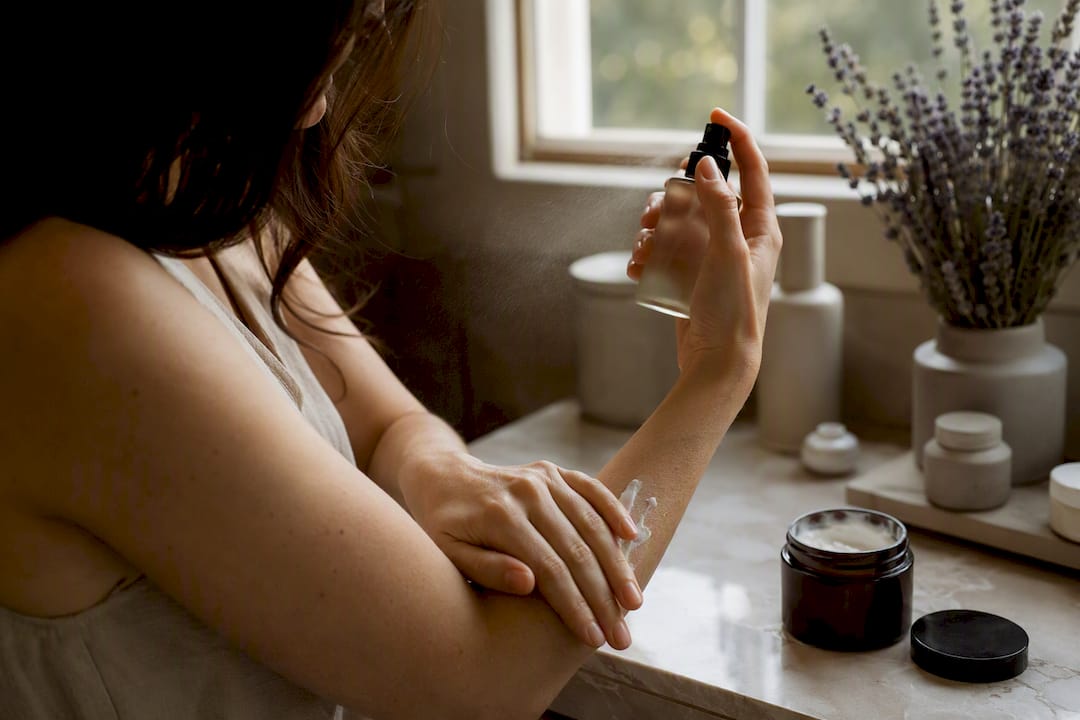
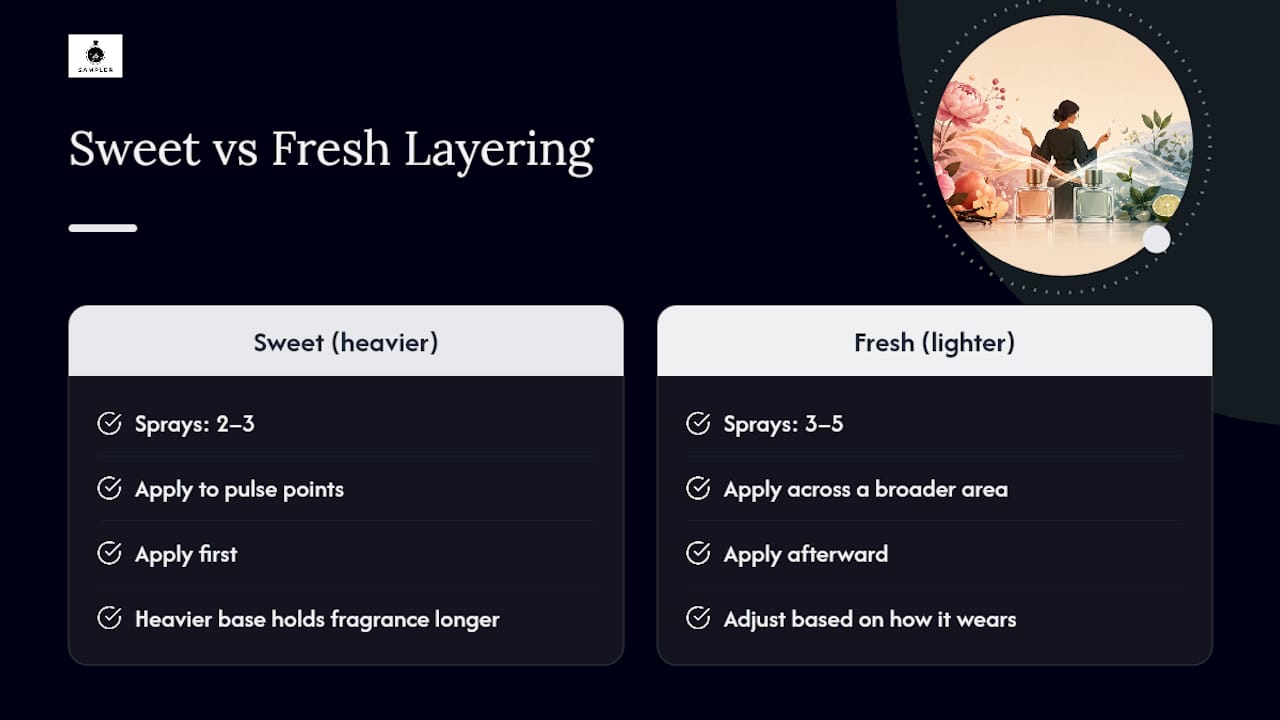
- Apply the heavier, sweeter scent to pulse points. Wrists, neck, and the inside of elbows work well. Use 2 to 3 sprays as your starting point.
- Let it dry for one to two minutes. This stops the layers blending wet, which tends to create a muddier result.
- Apply the fresher top layer more broadly. Use 3 to 5 sprays, spreading beyond pulse points to clothing, hair, and areas like behind the knees.
- Reassess after an hour. The drydown will tell you whether your ratio needs adjusting next time.
Placement affects outcome as much as spray count. Pulse points run warm and project the scent upward, which is ideal for your lead fragrance, while spraying the lighter top layer onto hair or clothing gives you a longer-lasting trail without adding more product to skin. Be careful with delicate fabrics like silk, which can stain or discolour under direct spray.
Format choice shapes projection and longevity too. Creams and oils sit closer to the skin and offer a quieter, longer base note, which makes them a strong choice for the sweet half of the pairing. Hair mists throw scent every time you move, useful for the fresh top note. Standard EDP or EDT sprays give you the most control over exact dosing, which matters when you’re still calibrating ratios.
Fresh and sweet fragrance pairings to try first
These pairings use generic, descriptive labels rather than specific brand names, so you can match them against whatever’s already in your collection.
Easy pairings (higher chance of success, minimal adjustment needed):
- Citrus cologne + vanilla gourmand. Apply the vanilla gourmand first at 2 to 3 sprays on pulse points, then the citrus cologne at 3 to 4 sprays over the top. The drydown settles into a warm, sunny vanilla with citrus brightness fading first.
- Green aromatic + light caramel. Caramel base first, green aromatic on top. Expect the caramel to soften into a toasted, herbal warmth once the green top note clears after 20 to 30 minutes.
- Aquatic musk + soft amber. Amber as the lead at 2 sprays, aquatic musk layered at 3 to 4 sprays. This combination tends to settle into a clean, skin-like warmth that reads as more “you” than “perfume”.
- Salty-bergamot cologne + tonka bean base. Tonka first, bergamot cologne second. The tonka’s slightly nutty sweetness pairs naturally with bergamot’s salt-citrus edge.
Adventurous pairings (need careful ratio adjustment):
- Fig leaf and green tea + praline gourmand. Start conservatively, one spray of praline to three of the green fragrance, since praline notes can dominate fast.
- Lavender aromatic + brown sugar gourmand. Watch the ratio closely here; lavender’s herbal sharpness can clash with heavier sugar notes if the sweet layer is too strong.
- Mint and cucumber aquatic + creamy sandalwood. Micro-dosing the sandalwood rather than applying it at full strength keeps this one from tipping into heaviness.
- Rosemary aromatic + coconut gourmand. A genuinely adventurous pairing. Test on paper first, since coconut can read as either tropical-fresh or heavily sweet depending on the specific fragrance.
For heavier gourmand-style bases worth testing as a lead scent, something like Boss Bottled Absolu Parfum Intense gives you a rich, warm anchor to build a fresher top layer against.
How weather and product format change the balance
Heat changes the maths on every pairing you try. Warmer temperatures increase projection but also speed up evaporation, which means a ratio that felt balanced in winter can turn overpowering in summer, and one that felt subtle indoors can vanish outdoors within an hour. Skin temperature does the same job on a smaller scale: warmer skin projects sweet notes faster and further than cooler skin does.
Format trade-offs worth knowing:
- Cream or body butter: longest wear, lowest projection, ideal as a quiet sweet base.
- Perfume oil: sits close to skin, good for a controlled micro-dose of a heavy note.
- Hair mist: high movement projection, best for the fresh top layer.
- EDP/EDT spray: most precise for exact dosing and ratio control.
| Season | Adjustment | Skin prep |
|---|---|---|
| Summer | Lighter fresh top, fewer sweet sprays | Exfoliate, then moisturise lightly |
| Winter | More base intensity, sweet layer can lead | Moisturise generously before applying |
| Humid climates | Reduce total sprays by roughly a third | Apply to cooler areas like inner elbow |
What to do when a fresh and sweet mix goes wrong
Muddiness usually means you’ve layered two complex fragrances rather than one complex lead and one simple support. Overpowering sweetness almost always means the ratio ran the wrong way, too much base, not enough fresh top.
Quick fixes:
- Dilute an overly sweet blend by rubbing in a little unscented lotion over the area.
- Reposition your fresh spray to areas further from your face, like ankles or the small of the back.
- Add a citrus or green micro-spray as a counterweight if the sweetness has taken over.
- Blot with a tissue and reapply a lighter, fresher layer rather than starting from scratch.
Do: test on paper strips first, apply thinner layers than you think you need, and wait before reapplying. Don’t: stack two heavy gourmands, spray both scents at the same time, or judge a blend in the first five minutes.
A short checklist for picking your lead and support scents
Before you commit two fragrances to skin, ask yourself:
- Which scent do I want leading, and which is happy to sit behind it?
- What are the two or three dominant notes in each?
- Is one noticeably richer or longer-lasting than the other?
- Is there a shared note, or a contrast that complements rather than clashes?
- Would either fragrance overwhelm the other at full strength?
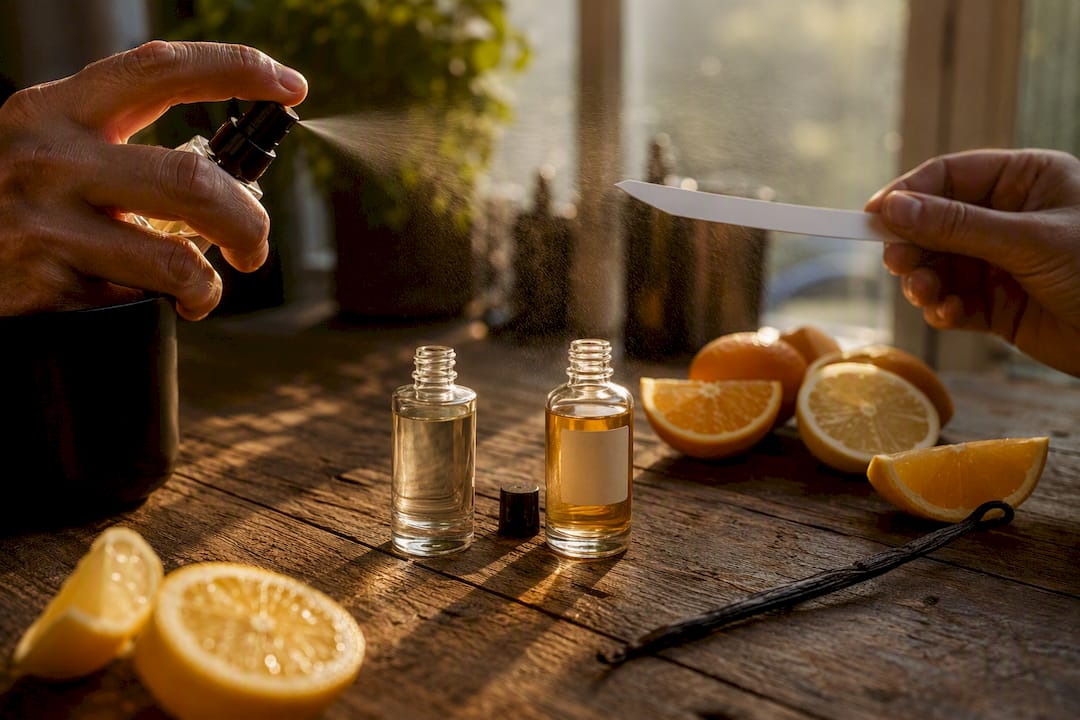
Listen for integration during the drydown, roughly 30 to 60 minutes in. A successful pairing stops smelling like “two perfumes” and starts smelling like one coherent scent with more depth than either had alone. The single best test is one spray of each on a paper strip, then a real application to skin, followed by an hour’s wait before judging.
Testing combinations before you commit to a full bottle
Working through pairings with full-size bottles is expensive and slow. A structured testing routine using smaller sizes solves both problems.
- Pick two candidates and note their names and concentrations.
- Apply on a quiet day, moisturised skin, lead scent first, support second, following your 1:3 starting ratio.
- Check in at 15 minutes, 1 hour, and 3 hours to track how the blend evolves.
- Log the result before moving to the next pairing, so you’re comparing notes rather than memory.
- Repeat with adjusted ratios if the first attempt leaned too sweet or too thin.
Practical sizing:
- 2ml to 5ml decants suit a single test or a one-off pairing experiment.
- 10ml sizes make sense once you’ve found a combination worth wearing repeatedly.
A simple tracking sheet helps more than memory does. Note the combo name, spray counts for each fragrance, the weather that day, how the blend evolved over three hours, and any adjustment you’d make next time. Testing at decant size rather than full bottle avoids wasting an expensive fragrance on a pairing that doesn’t work.
One combination that taught me the ratio rule
I once layered a heavy vanilla gourmand under a citrus cologne at equal strength and spent the whole day smelling like burnt sugar. Dropping the vanilla to two sprays and doubling the citrus fixed it completely.
Pro Tip: Start with just one pairing at a time and write down what happens. Small, documented experiments beat trying five combinations in one afternoon and remembering none of them clearly.
Test pairings affordably before buying full bottles
Testing eight or ten pairings with full-size bottles would cost a small fortune and leave you with fragrances you barely use. Decants and small samples solve that problem directly: you get to run the exact 1:3 ratio experiments covered above without gambling on a 100ml bottle you might not love.
For a single pairing test, a 2ml to 5ml decant gives you enough product for several days of trial without excess. Once you’ve found a combination worth wearing regularly, stepping up to a 10ml size covers repeated wear without the outlay of a full bottle. Theperfumesampler’s guide to why decants work explains the reasoning in more detail, and it’s worth a read if you’re new to sample-based testing.
Start by picking one fresh scent and one sweet scent from Theperfumesampler’s range in 2ml or 5ml sizes, run the testing protocol above over a weekend, and note what you’d change before ordering your next pairing.
Frequently asked questions about balancing fresh and sweet scents
How many sprays should I use when layering fresh and sweet scents? Start with 2 to 3 sprays of the sweeter, heavier scent and 3 to 5 sprays of the fresher scent, then adjust based on how it wears over the following hour.
Can I layer fresh and sweet scents from different brands? Yes. Layering across brands is standard practice and often gives more interesting results than sticking to one house, provided the two fragrances share complementary rather than competing notes.
Does layering fresh and sweet scents make perfume last longer? Often, yes. Moisturised skin combined with a heavier base layer tends to hold fragrance longer than a single lighter scent worn alone, since the sweet notes typically have better staying power.
What if my fresh and sweet combination smells muddy? Muddiness usually means both fragrances are too complex to layer cleanly. Swap the more complicated one for a simpler, single-note alternative and reduce the ratio of whichever scent feels dominant.
Is it better to apply the sweet or fresh scent first? Applying the heavier, sweeter scent first to pulse points and the fresh scent afterward across a broader area generally gives the most balanced, longest-lasting result.
Sources
- How to layer fragrances for a scent that’s uniquely yours | British Vogue
- An expert guide to scent layering – and why you should try it | The Independent
- Which fragrances layer well together: Pairing rules | WhatScent