

How does scent projection work: a clear guide
TL;DR:
- Scent projection measures the radius of detectable fragrance around your skin, not its strength or loudness. It depends on evaporation, diffusion, skin chemistry, and formulation, varying widely among individuals and environments. Understanding projection, sillage, and longevity allows for better fragrance selection and testing over time and conditions.
Most fragrance enthusiasts assume projection simply means how strong a perfume smells. That assumption leads to poor choices and real disappointment. How does scent projection work is one of the most searched questions in fragrance communities, yet most answers conflate it with longevity or sillage. These are three distinct aspects of performance. Understanding each one gives you far better control over how a fragrance behaves on your skin, how others perceive it, and which fragrances genuinely suit your needs.
Table of Contents
- Key takeaways
- How does scent projection work: the core science
- Factors affecting fragrance projection
- Projection vs sillage: understanding the difference
- Testing scent projection properly
- My honest view on projection misconceptions
- Try fragrances before you commit
- FAQ
Key takeaways
| Point | Details |
|---|---|
| Projection is not strength | Projection measures the radius a scent radiates from your skin, not how loud or potent it smells up close. |
| Skin chemistry changes everything | Oily, moisturised skin retains and projects scent longer than dry skin, regardless of fragrance concentration. |
| Sillage and projection differ | Projection is stationary; sillage is the trail you leave when moving. A fragrance can be strong in one and weak in the other. |
| Concentration does not equal projection | An extrait de parfum can project closer to the skin than a fresh eau de toilette with high volatile content. |
| Test over hours, not minutes | A single in-store sniff tells you almost nothing about real-world projection. Test at multiple time points for accurate results. |
How does scent projection work: the core science
Scent projection describes the radius around your body within which others can detect your fragrance when you are standing still. Think of it as a scent bubble that expands from the skin for roughly one to three hours after application, before gradually contracting as the volatile compounds evaporate.
The science behind this involves two physical processes: evaporation and diffusion. When you apply a fragrance, the alcohol carrier evaporates quickly, releasing fragrance molecules into the air around you. Those molecules then diffuse outward from the point of application. How far they travel depends largely on their molecular weight and volatility. Lighter, more volatile molecules, such as those found in citrus or green top notes, evaporate rapidly and disperse across a wider radius early in the wear. Heavier molecules, such as musks or woody base notes, evaporate more slowly and project at a shorter range, but they persist for much longer.
This is why understanding scent strength requires separating three concepts:
- Projection: The radius of detectable scent around a stationary wearer. Strongest in the opening phase.
- Sillage: The scented wake left in the air as you move through a space. Related to projection but driven by movement and airflow.
- Longevity: How long a fragrance remains detectable on your skin from application to fade.
A fragrance can have strong projection but weak sillage), or vice versa. These are separate but related qualities. Treating them as interchangeable leads directly to misreading a fragrance’s true performance.
A classic example: a heavy oriental fragrance with dense base notes may project only 30 centimetres from your skin after the dry-down, but it will still be detectable on your clothing 12 hours later. Conversely, a bright aquatic with strong citrus and ozonic notes may project boldly for the first 90 minutes, then fade almost completely. Neither is better. They serve different purposes.
Factors affecting fragrance projection
Several variables determine how well a fragrance projects on any given person, on any given day. The same bottle can perform quite differently depending on your skin, your environment, and the formulation itself.
Skin type and chemistry
Your skin is the primary diffuser. Moisturised skin enhances projection by slowing the evaporation rate and allowing the fragrance to unfold more gradually. Dry skin, on the other hand, absorbs the fragrance quickly and speeds up the evaporation process, shrinking the scent bubble and shortening the projection phase. Skin pH and natural oil production also affect how fragrance molecules interact with the surface.
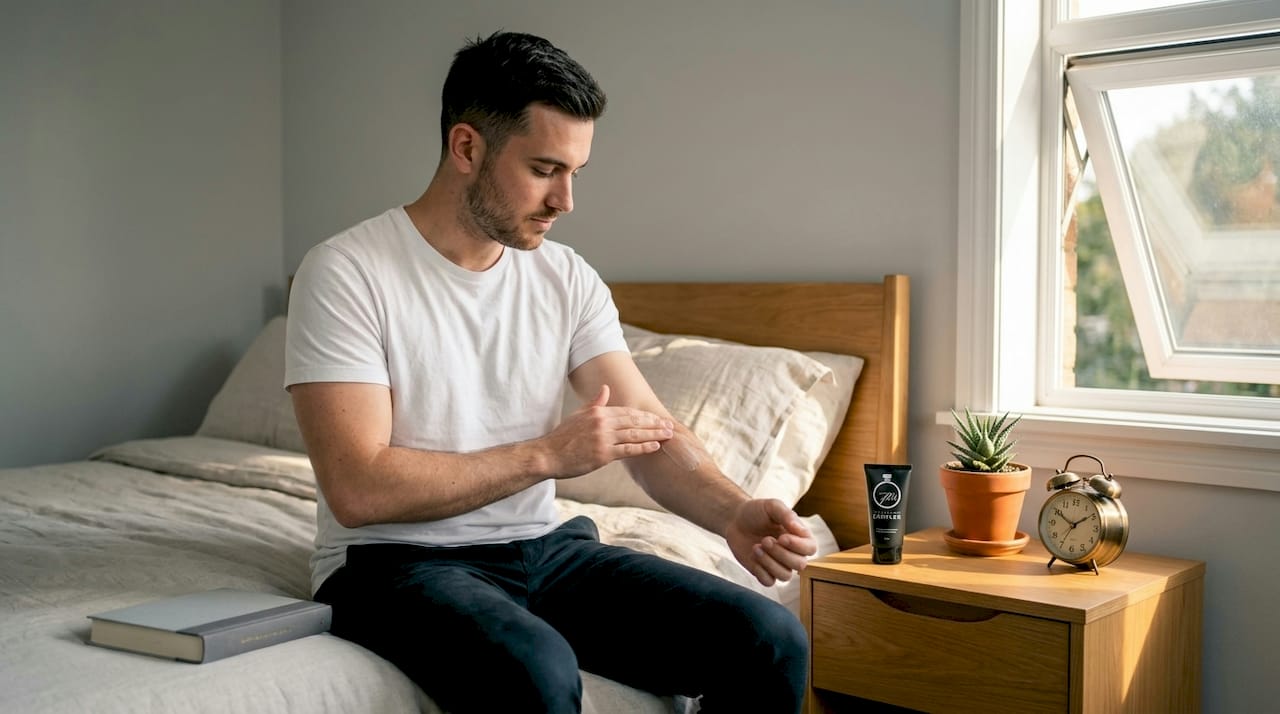
This is why two people wearing the same fragrance can have entirely different experiences. One person may find it projects boldly across a room; another may find it stays close to the skin after an hour.
Temperature, humidity, and airflow
Heat increases diffusion, pushing molecules outward more aggressively. Applying a fragrance in summer or warm indoor conditions will noticeably increase projection compared to a cold winter environment. Humidity plays a role too: a moderate level of humidity helps fragrance molecules stay suspended in the air, which supports projection. Very dry air accelerates evaporation and dispersal, reducing the time molecules remain detectable.
Airflow is worth factoring in. Light indoor ventilation can carry a scent trail further, which is actually a function of sillage rather than projection. In still air, projection remains more contained around the wearer.
Fragrance composition and concentration
Here is a point many enthusiasts get wrong. Higher concentration does not automatically mean greater projection. Formulation governs projection far more than concentration alone. An extrait de parfum with a dense, resinous base may wear close to the skin precisely because of its heavy molecular composition. Meanwhile, a light eau de toilette loaded with volatile aromatic compounds can radiate across a room.
The note families involved also matter considerably. Bright citruses and aromatics project well in the opening but fade fast. Musks and woods project softly but persist far longer. This is why perfume performance factors are worth understanding in full before making any purchase decision.
- Citrus and green notes: high early projection, short duration.
- Florals and spice: moderate projection, moderate duration.
- Musks and ambers: lower projection radius, significant longevity.
- Woody and resinous bases: close projection, exceptional longevity on skin and fabric.
Pro Tip: Apply an unscented moisturiser to your skin before spraying your fragrance. This simple step slows evaporation and meaningfully extends the projection phase, particularly on naturally dry skin.
Projection vs sillage: understanding the difference
These two terms are frequently used interchangeably in fragrance communities. They are not the same thing. Getting this distinction right changes how you evaluate and select fragrances.
Projection is a stationary measurement. It describes how far your scent radiates when you are not moving. Sillage is dynamic. It describes the scented trail left when moving through a room or past another person. A fragrance that leaves an unforgettable impression as you walk past someone has strong sillage. A fragrance someone notices only when sitting close to you has good projection but modest sillage.
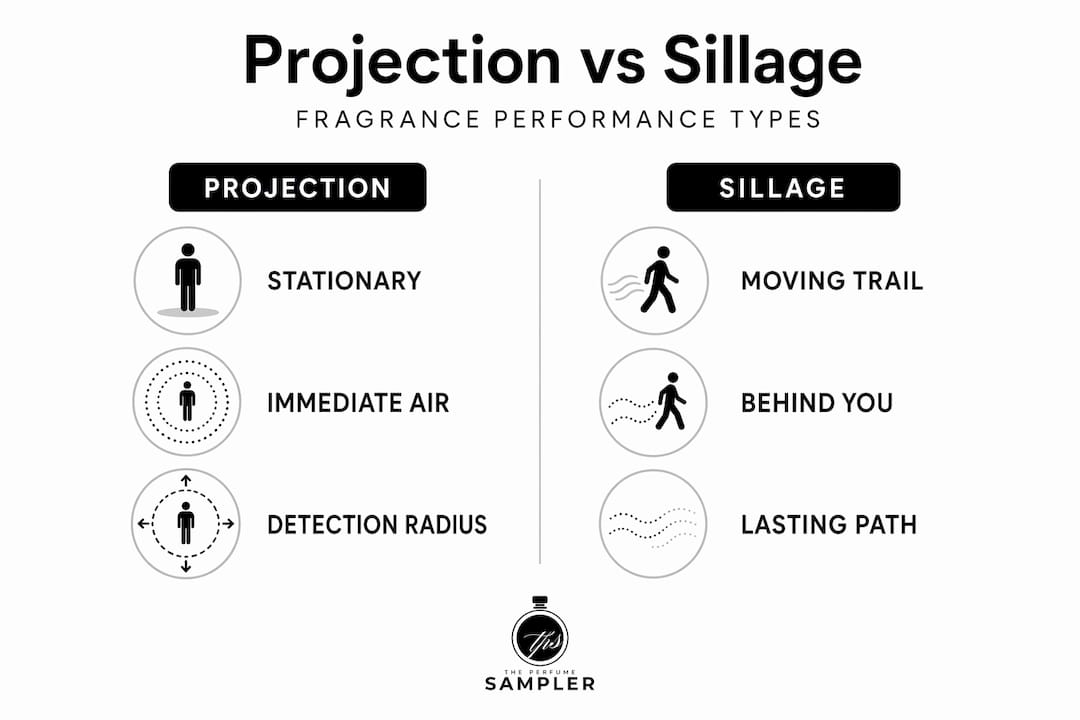
Time also alters both qualities in different ways:
| Stage | Projection | Sillage |
|---|---|---|
| Opening (0–30 mins) | Strongest, widest radius | Often bold, easily detected when moving |
| Heart (1–3 hours) | Moderate, stable scent bubble | Softer trail, still detectable on movement |
| Dry-down (3–6 hours) | Close to skin, minimal radius | Faint trail, most noticeable on warm fabric |
| Late stage (6+ hours) | Skin scent only | Negligible unless applied to clothing |
Understanding this timeline matters practically. If you need a fragrance to project in a business meeting for two hours, look for strong heart note projection. If you want to leave an impression at an event as you arrive and move around, prioritise sillage. The two goals call for different fragrance profiles.
Scent radiance and sillage together form the full picture of how a fragrance performs in social settings. Neither quality alone tells the complete story.
Testing scent projection properly
A reliable guide to testing scent projection means going beyond the immediate first impression. Single-impression testing misrepresents true scent performance. You need multiple check-ins over several hours to understand how a fragrance actually behaves.
Here is how to approach it:
- Apply to a non-pulse area first. Pulse points inflate early projection due to concentrated heat and blood flow, which can create a misleadingly strong opening impression. The inner elbow or forearm gives a more realistic result.
- Check at 15 minutes, 1 hour, 3 hours, and 6 hours. Each stage tells you something different about projection behaviour.
- Do not rub your wrists together. Overspraying or rubbing wrists flattens the opening and compresses the projection stage. Spray and let it settle.
- Ask someone else. Olfactory fatigue sets in quickly. Your own nose adapts to the scent faster than you realise. Another person can give you honest feedback on both projection and sillage.
- Test on moisturised skin. Moisturised skin boosts projection and gives a more accurate picture of how the fragrance will perform in real wear conditions.
Clothing also plays a role. Fabric holds scent longer than skin in most cases, which can extend perceived sillage into the late wear stage. Bear in mind that some fragrances, particularly dark orientals and oud-based compositions, can stain lighter fabrics permanently.
Pro Tip: Test fragrances both indoors and outdoors. Temperature fluctuations affect evaporation rates significantly, and a fragrance that projects superbly in a warm room may behave very differently in cooler outdoor air.
You can also find more detail on applying these principles practically with the men’s grooming application guide at NORML, which covers how application technique influences fragrance performance.
My honest view on projection misconceptions
I have spent years testing fragrances across concentrations, climates, and skin types, and the same misunderstanding comes up constantly. People judge projection in the first five minutes and then wonder why a fragrance that smelled incredible in the shop performs poorly by lunchtime.
The truth is, projection is not a fixed attribute of a bottle. It is a negotiation between the formula, your skin, and the environment. I have worn fragrances that project aggressively on dry winter skin and barely register on the same fragrance in humid summer conditions. That is not a bad batch. That is chemistry.
What I find enthusiasts miss most often is the dry-down. The opening phase gets all the attention, but the behaviour between hours two and four is where a fragrance reveals its true character. A fragrance that projects modestly but consistently through that window is often far more wearable than something that opens loudly and collapses by the first hour.
My advice: resist buying based on a first impression. Wear something through a full day before committing. Your skin, your routine, and your environment will tell you far more than any brief test strip ever could.
— Rupesh
Try fragrances before you commit
Understanding how scent projection works is one thing. Experiencing it across different fragrances on your own skin is another entirely. That is exactly where Theperfumesampler helps. Rather than guessing how a fragrance will perform from reviews alone, you can try decants before buying in 2ml, 3ml, 5ml, and 10ml sizes. Every decant is drawn from 100% authentic bottles of high-end niche and designer fragrances. Test projection over a full day, compare sillage across multiple options, and make informed decisions without full-bottle risk. Explore the full range at Theperfumesampler.
FAQ
What is scent projection in perfumery?
Scent projection is the radius within which others can detect your fragrance when you are standing still. It is strongest in the first one to three hours after application, then gradually decreases as volatile compounds evaporate.
How does scent projection differ from sillage?
Projection is a stationary quality, describing how far a scent radiates from your skin at rest. Sillage is dynamic, referring to the scented trail you leave behind when moving through a space.
Does higher fragrance concentration mean better projection?
Not necessarily. Formulation governs projection more than concentration. An extrait with heavy base notes can project closer to the skin than a lighter eau de toilette rich in volatile, high-diffusion compounds.
How can I improve my fragrance’s projection?
Apply an unscented moisturiser before spraying, target consistent application areas, and avoid rubbing wrists together. Moisturised skin slows evaporation and extends the projection phase noticeably.
Why does the same fragrance project differently on different people?
Skin chemistry, natural oil levels, pH, and hydration all affect how fragrance molecules evaporate and diffuse. These variables are individual, which is why the same fragrance can project boldly on one person and softly on another.
Recommended
- Perfume projection: How scent radiance shapes your experience – ThePerfumeSampler
- Sillage in perfume: What the scented trail reveals – ThePerfumeSampler
- Why professionals wear perfume: confidence, branding, and scent – ThePerfumeSampler
- Guide to fragrance scent mapping for enthusiasts – ThePerfumeSampler