
The role of scent in workplace productivity
TL;DR:
- Most workplaces overlook the impact of scent on employee well-being, despite its influence on mood and focus. Effective scent management requires addressing ventilation, sensitivities, and policies, with careful testing and integration into the broader environmental quality system. Proper application enhances comfort and productivity while safeguarding inclusivity and legal compliance.
Most professionals give little thought to what their office smells like. That is a missed opportunity. The role of scent in workplace well-being and performance is well-documented in occupational psychology and environmental science, yet it remains one of the least managed variables in most office environments. What the nose detects shapes mood, sharpens focus, and can either improve or undermine how people feel at their desks. This article explains the science, the practical benefits, the real risks, and the management strategies that actually work.
Table of Contents
- Key takeaways
- How scent affects mood and cognition at work
- Scent and indoor environmental quality
- Challenges and risks of workplace fragrance
- Practical scent strategies for managers
- My view: scent is a system, not a shortcut
- Try scents before you commit
- FAQ
Key takeaways
| Point | Details |
|---|---|
| Scent connects directly to emotion | Olfactory signals reach the brain’s limbic system faster than any other sense, producing immediate mood responses. |
| Scent is part of a broader system | Fragrance influence on focus works best when paired with good ventilation, lighting, and thermal comfort. |
| Sensitivities require clear policies | Scent-free zones and accommodation procedures protect workers with environmental sensitivities and fulfil legal duties. |
| Pilot before you commit | Test any scent intervention with staff consultation and a feedback mechanism before rolling it out widely. |
| Personal choices affect colleagues | Individual fragrance use at work requires awareness and guidance, not just ambient scent decisions. |
How scent affects mood and cognition at work
The formal term for this field of study is environmental olfaction, and researchers have been building its evidence base for decades. Unlike sight or hearing, smell does not route through the thalamus before reaching conscious awareness. Olfactory signals connect directly to the amygdala and hippocampus, the brain regions that govern emotion and memory. The result is a response that is immediate and largely non-conscious. You notice a smell and your mood shifts before you have processed why.
This neurobiological shortcut has direct relevance for workplace managers. It means that the scent environment in an office is already influencing employee behaviour whether or not anyone has made a deliberate choice about it. Stale air, cleaning product residue, food smells from a nearby kitchen, or a colleague’s heavy cologne all land in the limbic system and produce a response.
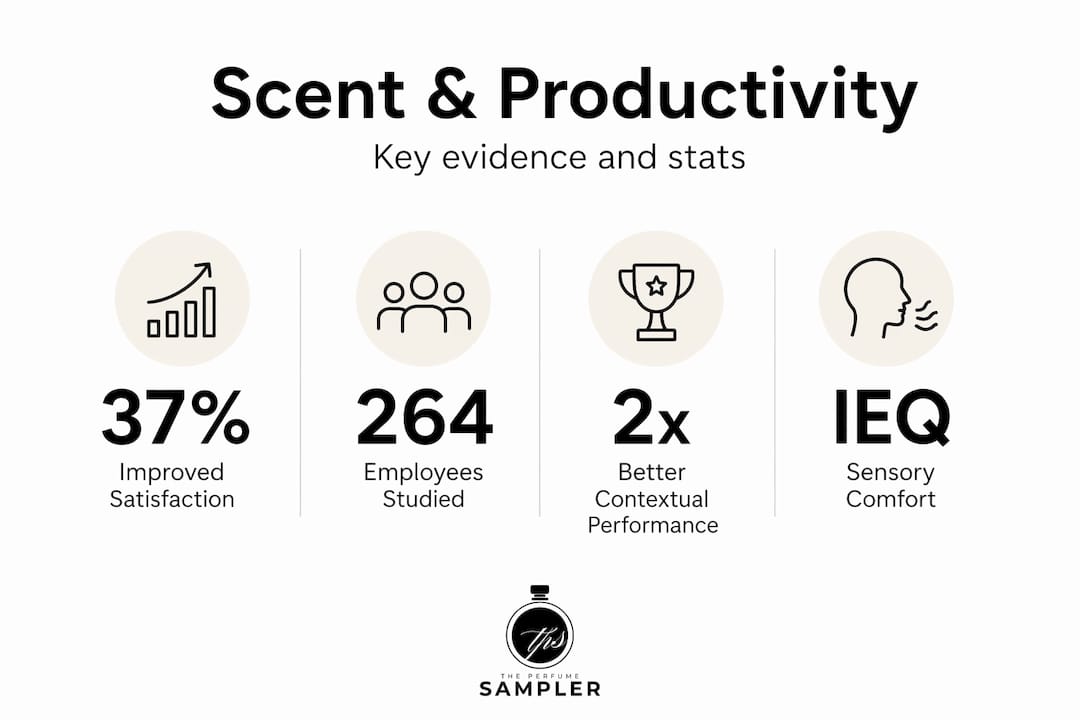
Research in applied settings supports this. In a multicentre study of healthcare workers, stress scores fell by 59.1% after sessions in Recharge Rooms that included essential oil diffusers alongside natural elements. Alertness increased by 35.1% and feelings of hopefulness rose by 29.6%. Healthcare workers represent a high-stress, high-demand population, which makes the magnitude of these results particularly notable.
That said, responses to scent are not uniform across individuals. Personal history, cultural associations, and sensitivity levels all modulate how any given fragrance is received. What calms one person can trigger a headache in another. This variability is not a reason to dismiss scent management. It is a reason to approach it carefully.
- Citrus and peppermint scents are associated with increased alertness in several studies
- Lavender is linked to stress reduction and calming effects in controlled trials
- Eucalyptus and rosemary have been connected to improved recall in cognitive testing
- Unpleasant or unfamiliar odours consistently reduce comfort scores and task focus
Pro Tip: Before investing in any ambient scent system, conduct a brief staff survey about existing sensitivities and odour preferences. The data will shape a better decision and head off complaints before they arise.
Scent and indoor environmental quality
Scent does not operate in isolation. Understanding the benefits of scent in office settings requires placing it within the wider framework of Indoor Environmental Quality, known in occupational health circles as IEQ. IEQ covers thermal comfort, air quality, lighting, acoustics, and sensory factors including smell.
A study of 264 employees found that sensory IEQ comfort, including scent, influenced workplace satisfaction and well-being through what researchers call total environmental comfort mediation. In plain terms, scent works better when the rest of the physical environment is also well-managed. An office with excellent fragrance and poor ventilation is still an uncomfortable office.

Air movement matters enormously here. Stagnant air reduced contextual performance in regression analysis, with a measurable negative coefficient on employee output and an increase in counterproductive work behaviour. Poor ventilation allows odours to accumulate, compounds the perception of stuffiness, and adds a low-level stressor that compounds over a full working day.
| Environmental factor | Effect on comfort | Interaction with scent |
|---|---|---|
| Ventilation and air movement | Removes stagnant odours | Disperses ambient fragrance evenly |
| Thermal comfort | Affects perceived air quality | Warm rooms intensify odour perception |
| Lighting quality | Influences mood and alertness | Works alongside scent on the same limbic pathways |
| Acoustic comfort | Reduces cognitive load | Compounds the effect of calming ambient scents |
The practical implication is that odour control is best addressed through engineering air movement and ventilation first, then considering fragrance as a supplementary measure. A well-ventilated space also distributes any introduced scent more effectively and reduces the risk of localised overexposure.
Pro Tip: If you manage an office retrofit or refurbishment, include a conversation with your HVAC engineer about scent management. Diffuser placement and air circulation patterns are directly related.
Challenges and risks of workplace fragrance
The aroma and productivity conversation often gets stuck on the positive side. The risks are equally real and deserve direct attention.
A significant proportion of the working population experiences environmental sensitivities. These range from mild discomfort around strong fragrances to diagnosed conditions such as multiple chemical sensitivity, where exposure to certain compounds triggers neurological, respiratory, or dermatological symptoms. The Canadian Human Rights Commission has established that scent-free policies are accessibility measures with a legal duty to accommodate, consult, and inform.
This creates a real tension for managers. Introducing a scent wellness programme without adequate policy infrastructure may constitute a failure to accommodate employees with sensitivities. The legal and ethical obligations sit alongside the wellness goals, not below them.
Design research on aromatherapy as a workplace intervention found that simple aromatherapy is not a universal fix. Scent interventions can provoke social and technical tensions in office environments, particularly where workers have no control over their exposure to introduced fragrances.
Key risks to manage include:
- Adverse reactions including headaches, nausea, and respiratory symptoms from uncontrolled fragrance exposure
- Equity concerns when some workers benefit from scent interventions while others are harmed by them
- Compliance failures if no accommodation pathway exists for workers who report symptoms
- Social friction when personal fragrance choices conflict with a colleague’s health needs
Scent-free zones are a practical tool, but they require more than a sign on the door. They require consultation, awareness raising, and accommodation procedures that give affected workers a clear route to relief. Awareness programmes should address both ambient scent decisions and personal fragrance use, since both affect the shared environment. For guidance on choosing personal scents that are appropriate for professional settings, the professional fragrance guide at Theperfumesampler covers the relevant considerations clearly.
Practical scent strategies for managers
Managing scent in a professional environment calls for a structured approach, not a diffuser on the reception desk and good intentions. Here is a practical framework:
- Audit the existing scent environment. Walk the space and note what staff already experience. Identify stagnant air zones, areas with strong food odours, and any existing fragrance sources. This baseline shapes every subsequent decision.
- Address ventilation before fragrance. Fix poor air circulation through HVAC adjustment, desk fans, or air purifiers before introducing any deliberate scent. Improving air movement removes the conditions that make odours unpleasant and supports any fragrance you do introduce later.
- Consult employees before piloting. Run a short survey or focus group. Ask about known sensitivities, existing concerns, and preferences. Document responses. This is both good practice and important evidence if a legal accommodation question arises later.
- Draft a scent policy that covers both personal and ambient fragrance. The policy should acknowledge environmental sensitivities, outline expectations for personal fragrance use, and establish a clear reporting and accommodation process. Signage should follow from the policy, not substitute for it.
- Pilot any scent intervention in a limited area with clear governance. Select a willing team or a single zone. Set a timeframe, collect feedback, and review before expanding. Governance structures for scent pilots should include education materials, accommodation pathways, and an explicit response plan for any adverse reactions.
- Treat scent as part of the IEQ system. Coordinate fragrance decisions with thermal comfort, lighting, and acoustic management. The evidence shows that scent alone rarely drives satisfaction without the rest of the sensory environment working alongside it.
Understanding how smell and workplace performance interact is genuinely useful for managers. The best workplace perfumes for office wear resource from Theperfumesampler offers practical guidance on personal scent choices that sit within an inclusive and considered office culture.
My view: scent is a system, not a shortcut
I’ve watched plenty of well-meaning managers order a lavender diffuser for the break room and consider the job done. It rarely is. What I’ve learned from following the research and speaking with workplace professionals is that scent management is genuinely more complex than it looks from the outside.
The science on olfactory pathways to the limbic system is not in dispute. Scent does affect mood and cognition. But the gap between laboratory findings and open-plan office reality is significant. In a lab, participants experience a controlled scent in a controlled setting. In an office, they experience that scent on top of a colleague’s aftershave, residual coffee fumes, a slightly too-warm room, and the sound of a nearby phone call. The variables stack up.
My honest view is that managers should spend more time on the unsexy fundamentals, ventilation, air quality, thermal comfort, before reaching for a diffuser. Getting those right makes every other sensory intervention more effective. Scent is a multiplier. It amplifies a good environment and, if the basics are wrong, it can amplify a bad one too.
I also think the accessibility dimension is underestimated. In my experience, workers with fragrance sensitivities often feel reluctant to raise the issue because fragrance use feels personal and therefore untouchable. Clear policy changes that. It gives everyone a shared framework. That is not a constraint on scent management. It is what makes scent management actually work.
— Rupesh
Try scents before you commit
Choosing the right fragrance for a professional environment involves more than reading a description online. Theperfumesampler offers fragrance decants in 2ml, 3ml, 5ml, and 10ml sizes, so professionals can test how a scent performs across a working day before investing in a full bottle. Every decant is 100% authentic and sourced from genuine full bottles. Whether you are selecting a personal signature scent for the office or exploring why decants are a smarter route to finding the right fragrance, Theperfumesampler makes the process straightforward and cost-effective. Browse the full range at Theperfumesampler and find a scent that works for your professional environment.
FAQ
How does scent affect mood at work?
Olfactory signals connect directly to the brain’s limbic system, producing non-conscious emotional responses. Research shows that specific scents such as lavender and citrus are linked to measurable reductions in stress and improvements in alertness.
What scents improve focus and productivity?
Peppermint, rosemary, and citrus-based scents are associated with improved alertness and cognitive performance in several studies. Effects vary between individuals, so piloting scents with staff feedback is advisable before full implementation.
Can employers legally require scent-free workplaces?
Yes. Scent-free policies are recognised as accessibility measures under human rights frameworks in several jurisdictions. Employers have a legal duty to consult, inform, and accommodate workers with environmental sensitivities.
Should ventilation be addressed before introducing workplace scent?
Ventilation should come first. Poor air movement is independently linked to reduced workplace performance, and addressing it makes any subsequent scent intervention more effective and more evenly distributed across the space.
What is the difference between ambient scent and personal fragrance at work?
Ambient scent refers to deliberately introduced fragrances via diffusers or HVAC systems, while personal fragrance covers individual perfume or aftershave use. Both affect the shared scent environment and should be addressed within a workplace fragrance policy.
Recommended
- The best workplace perfumes for everyday office wear – ThePerfumeSampler
- Why professionals wear perfume: confidence, branding, and scent – ThePerfumeSampler
- Work professional fragrance guide: select, sample and impress – ThePerfumeSampler
- Top fragrances for professionals: elevate your scent – ThePerfumeSampler