
Cloudy Perfume: What to Do and When to Stop Using It
If your perfume has turned cloudy, do not spray it again straight away. First bring the bottle to a steady room temperature and leave it for a day. Then look at it in good light and smell it. Haze that clears and a scent that is unchanged is usually a temperature effect. Haze that stays, flakes, separate layers or a sour smell mean the bottle should be retired. This guide shows you how to tell the difference, what not to do, and how to keep the next bottle clear.
We sell decants and full bottles, so we see why this question matters. A perfume you cannot trust is a wasted purchase. Everything below is written for wearers, not for people mixing their own perfume.
TL;DR
- Cold is the most common harmless cause. Let the bottle sit at room temperature for a day and see whether it clears.
- Haze that stays, flakes, oily layers, or a sour, sharp or metallic top note mean you should stop using that bottle.
- Do not add alcohol or water, and do not heat the bottle. Home repairs make things worse.
- Citrus-heavy fragrances change fastest, so small sizes are a safer way to use them.
- Store perfume cool, dark and upright in its box, away from cars, windowsills and bathrooms.
Table of Contents
- Why perfume turns cloudy
- Step 1: Check where the bottle has been
- Step 2: Let it settle at room temperature
- Step 3: Read what you see
- Step 4: Smell it before you spray it
- What not to do
- When to stop using the bottle
- Contacting the seller
- How to keep perfume clear
- Why smaller sizes keep perfume fresher
- Perspective
- Try before you commit
- FAQ
- Sources
Why perfume turns cloudy
A bottle of perfume is a mix of fragrance oils dissolved in alcohol, usually with a little water. Cloudiness means something in that mix is no longer fully dissolved, or something has got in. The causes break down like this:
- Cold. Some materials dissolve less well as the temperature drops. Veriscents explains that a blend that is clear at room temperature may haze when chilled, and that this can be a physical change rather than a chemical one. So haze alone does not prove the perfume has oxidised.
- Crystals and waxy components. PerfuMate lists wax from natural extracts, crystals from materials such as vanillin, coumarin or ambroxan, water getting into the alcohol, and cold as the usual causes. It adds that most haze does not change the smell.
- Oil droplets or particles. In an alcohol-based perfume, haze can come from microscopic oil droplets or small solids that have come out of solution.
- Age and oxidation. When a bottle has been open for years, or kept warm, the fragrance itself breaks down. Here the cloudiness comes with a colour shift and a changed smell.
The point for you: appearance narrows the options but does not settle them. Fragrans cautions that looks alone cannot identify the cause, because solubility, temperature, formula interactions, packaging and contamination are different possibilities.
Step 1: Check where the bottle has been
Start with the recent history. Did the bottle arrive in winter? Was it in a car, a bag by a window, a cold garage or a bathroom? Did it travel in a cold cargo hold?
Perfume moved between cold and warm places can cloud for a while, and temperature-related haze often clears once the liquid settles at a steady temperature, according to Scentella. If the bottle came through freezing weather, our guide on whether perfume can freeze in the mail explains what cold does to it. Heat is the other side of the same problem, covered in what heat does to perfume stored in a car.
Write down the date you first noticed the haze and where the bottle had been. You will want that if you contact the seller.
Step 2: Let it settle at room temperature
Put the bottle, cap on, upright in a room at a normal indoor temperature. Keep it out of direct sun. Leave it for 24 hours.
Marie Claire quoted Sabah Karimi, founder of VEXA Beauty, in January 2026. Her view: a harmless haze from cold clears with warming, while a haze that lingers, flakes, or oil-and-water layering are warning signs.
Two things to avoid while you wait:
- Do not shake the bottle to see whether it mixes. Shaking adds air and stirs up whatever has settled. We explain more in our piece on whether you should shake perfume.
- Do not speed things up with a hair dryer, microwave, hot water or a stove. Fragrans notes that heating with an appliance or soaking in hot water is not a controlled test. It also warns that “it cleared in the fridge” is not proof the perfume is fine. Our note on why the fridge is not the answer covers storage in more detail.
Step 3: Read what you see
After a day, compare the bottle against this table.
| What you see | What it usually points to | What to do |
|---|---|---|
| Clear again, same colour, same smell | Temperature haze | Keep using it, store it better |
| Light even haze, smells normal | Dissolved material shifting, often cold or natural-heavy blends | Watch it for a few days and keep it at a steady temperature |
| Haze that does not clear after a day | Something not dissolving | Stop using it and contact the seller |
| Flakes, floating specks or sediment | Solids or contamination | Stop using it |
| Two layers, oil on top or water below | Separation | Stop using it |
| Darker colour plus haze plus sour smell | Oxidation | Retire the bottle |
Colour matters as much as cloud. Karimi told Marie Claire that colour changes beyond a gentle ambering mean chemical breakdown. Examples are straw turning tea-brown, murky olive casts or sudden orange. Our guide to a perfume that has changed colour walks through those shades in detail.
Haze and sediment are not the same thing. Fragrans points out that haze spreads through the liquid while sediment settles. Describe which one you see if you contact the seller.
Step 4: Smell it before you spray it
Your nose is the best test. Pia Long, Head Perfumer at Olfiction, told Marie Claire that the top note usually goes first and can smell soured, acidic, minty or like bug spray. She said smell is the most reliable sign that a perfume has turned.
Smell the cap or a strip of blotting paper, not your skin. If the opening smells sharp, sour or metallic, stop there.
A mild haze does not always smell perfect either. PerfuMate’s Omer Siton explains that undissolved specks release material unevenly onto a strip and the alcohol reads sharper against them. A hazy perfume can therefore smell rougher than the same formula when clear.
Some families age faster than others. Karimi says citrus- and aldehyde-heavy fragrances deteriorate fastest because their ingredients oxidise easily. Amandine Pallez, Bvlgari Parfums senior creative director, told Byrdie that perfumes do not simply fade. They oxidise and turn sour, acidic or metallic, with citrus and aromatic top notes at most risk. She also noted that more oxygen above the liquid speeds oxidation, so saving the last drops in a bottle is a bad idea.
What not to do
It is tempting to fix a cloudy bottle. For a finished commercial perfume, do not.
- Do not add water, vodka, rubbing alcohol, essential oil or glycerin. Xuelei’s consumer guidance says not to repair separated commercial perfume at home or to add any of these.
- Do not heat it. The same guidance rules out microwaves, hair dryers, hot water baths, stoves and open flames. Perfume is flammable, and heating it near a flame or hot appliance is a real fire risk.
- Do not filter it through coffee filters or cloth. Filtering is a tool for people making perfume, and even they are cautioned. Veriscents notes it may strip fragrant parts and change the formula. A filtered bottle is also no longer the perfume the house made.
- Do not spray on skin to test. If you have any doubt, you are putting an unknown mix on your skin.
When to stop using the bottle
Stop using it if any of these apply:
- The haze does not clear after a day at room temperature.
- You see flakes, particles or two layers.
- The smell is sour, sharp, metallic or like bug spray.
- The colour has darkened noticeably or turned murky.
- The bottle is leaking or the sprayer is damaged.
- Your skin reacts when you wear it. Stop wearing it and see a doctor or pharmacist if irritation persists.
Cloudy perfume is not automatically dangerous. Scentella says safety depends on the cause. That is why the safest habit with an unexplained change is to stop spraying it on skin.
If you want to air out a room that smells strongly of a spoiled bottle, open a window first. For choosing home fragrance with air quality in mind, read about incense or a diffuser at home.
Contacting the seller
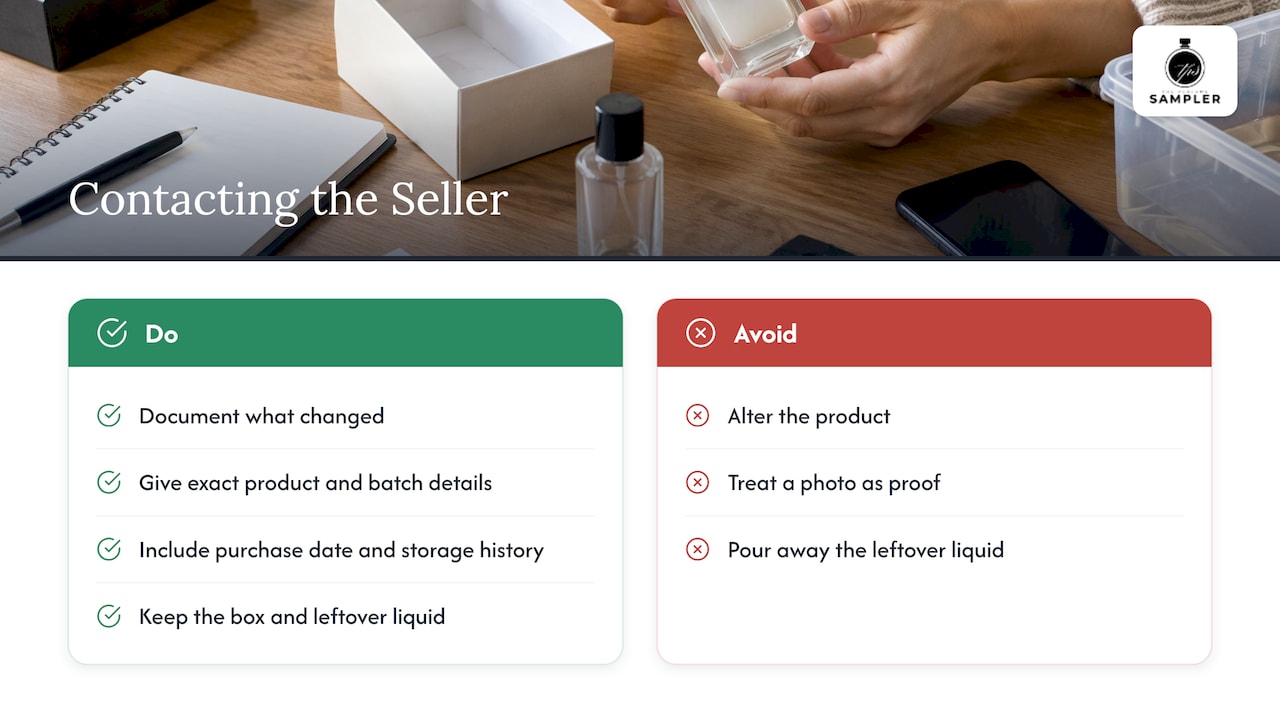
For a bottle with persistent separation, new particles, a strong change in smell or leakage, the next step is the seller. Fragrans recommends documenting what changed without altering the product, then giving the maker or seller the exact product and batch details. A photograph cannot prove a bottle has spoiled or is counterfeit, so include the purchase date, the batch code on the box or bottle, and a description of where the bottle has been kept.
Keep the box and the leftover liquid. Do not pour it away until the matter is settled.
This is also why where you buy matters. We stand behind the authenticity of every fragrance we sell, and our customers rate us excellent on TrustPilot. Knowing a bottle is genuine removes one unknown when you are working out why something looks odd.
How to keep perfume clear
Most cloudiness and spoilage starts with storage. A few habits cover nearly all of it.
- Keep it at a steady, cool temperature. Temperature swings cause haze, and heat speeds ageing. Avoid cars, windowsills, radiators and bathrooms.
- Keep it in the dark. Light breaks down fragrance and darkens the liquid. The original box is a simple light shield. Our guide to storing perfume in its box shows how.
- Do not use the fridge as a default. A cold, repeatedly opened fridge brings the same temperature swings that cause haze. See the fridge guide linked above.
- Close the cap and keep it upright. Less air means slower oxidation.
- Do not shake it. Roll it gently if you must mix.
- Use bottles in good time. Our overview of how long perfume lasts covers shelf life and the signs of ageing.
Why smaller sizes keep perfume fresher
Oxygen is the reason a half-empty big bottle ages faster, as Pallez noted. The more air above the liquid and the longer a bottle sits, the more chances it has to change. If you wear a fragrance only now and then, or you own many, a 2ml, 3ml, 5ml or 10ml decant is used up before the air does much damage. It is also a cheaper way to find out whether you like a scent before you commit to a full bottle. Citrus-heavy and aldehyde-heavy scents, which age fastest, suit small sizes well. Our page on why decants make sense sets this out, and our guide on whether decants are safe answers the usual concerns.
Perspective
Most cloudy perfume questions we see come down to one thing: people hold on to a bottle for longer than the fragrance stays at its best. A big bottle bought on impulse sits on a shelf, gets warm, gets opened and closed, and slowly changes.
Our view is simple. Try a fragrance in a small size first. Decide you love it. Then buy the full bottle, and store it properly. A 2ml to 10ml decant lets you wear a fragrance through its best weeks, and a full bottle of a scent you wear often gets used before it can turn.
When a fragrance is genuine and stored well, haze is rarely a problem. That is why we put authenticity first, and why we recommend the small-size route for anything you are unsure about.
Rupesh
Try before you commit
We sell niche and designer fragrance samples in 2ml, 3ml, 5ml and 10ml sizes, as well as full bottles of luxury fragrances for men and women. Every fragrance carries our authenticity guarantee, and we offer discounted and free shipping thresholds and ship worldwide. Browse all fragrances to start with a decant, or see the full bottles once you have found a scent you wear often.
If you already know your pick, a bottle like BOSS Bottled Absolu Parfum Intense is a place to start.
FAQ
Is cloudy perfume safe to wear?
Not necessarily. Cloudiness can mean harmless cold haze, but it can also mean ingredients are separating or the perfume has broken down, and safety depends on the cause. If the haze clears at room temperature and the scent is unchanged, it is usually fine. If it stays or the smell has turned, stop using it.
Will cloudy perfume clear up on its own?
Often, if the cause was cold. Leave the sealed bottle at a steady room temperature for a day. Haze from temperature changes typically clears once the liquid settles. Haze that stays has another cause and the bottle should not be worn.
Can I fix cloudy perfume by adding alcohol or filtering it?
No. Adding water, alcohol or other liquids, heating the bottle or filtering it can change the formula and create safety risks. Contact the seller with the batch details and photos instead.
How can I tell if perfume has gone off?
Smell is the most reliable sign. A sour, sharp, metallic or bug-spray top note, a darker or murkier colour, or flakes and layers all point to a bottle that has turned. Citrus-heavy scents tend to show this first.
Sources
- How To Tell If Perfume Has Expired, According To Experts (Marie Claire)
- Does Perfume Expire? Fragrance Experts Weigh In (Byrdie)
- Why Fragrances Change Color, Cloud or Develop Sediment (Veriscents)
- Why is my perfume cloudy? Causes and filtering (PerfuMate)
- Why is my perfume cloudy or forming sediment? (Fragrans)
- Why Does My Perfume Turn Cloudy (Scentella)
- Why Does Perfume Separate (Xuelei)